
(Why We’re in) A New Age of Global Conflict
Guess What the Flipside of “Democracy’s Dying” Is?
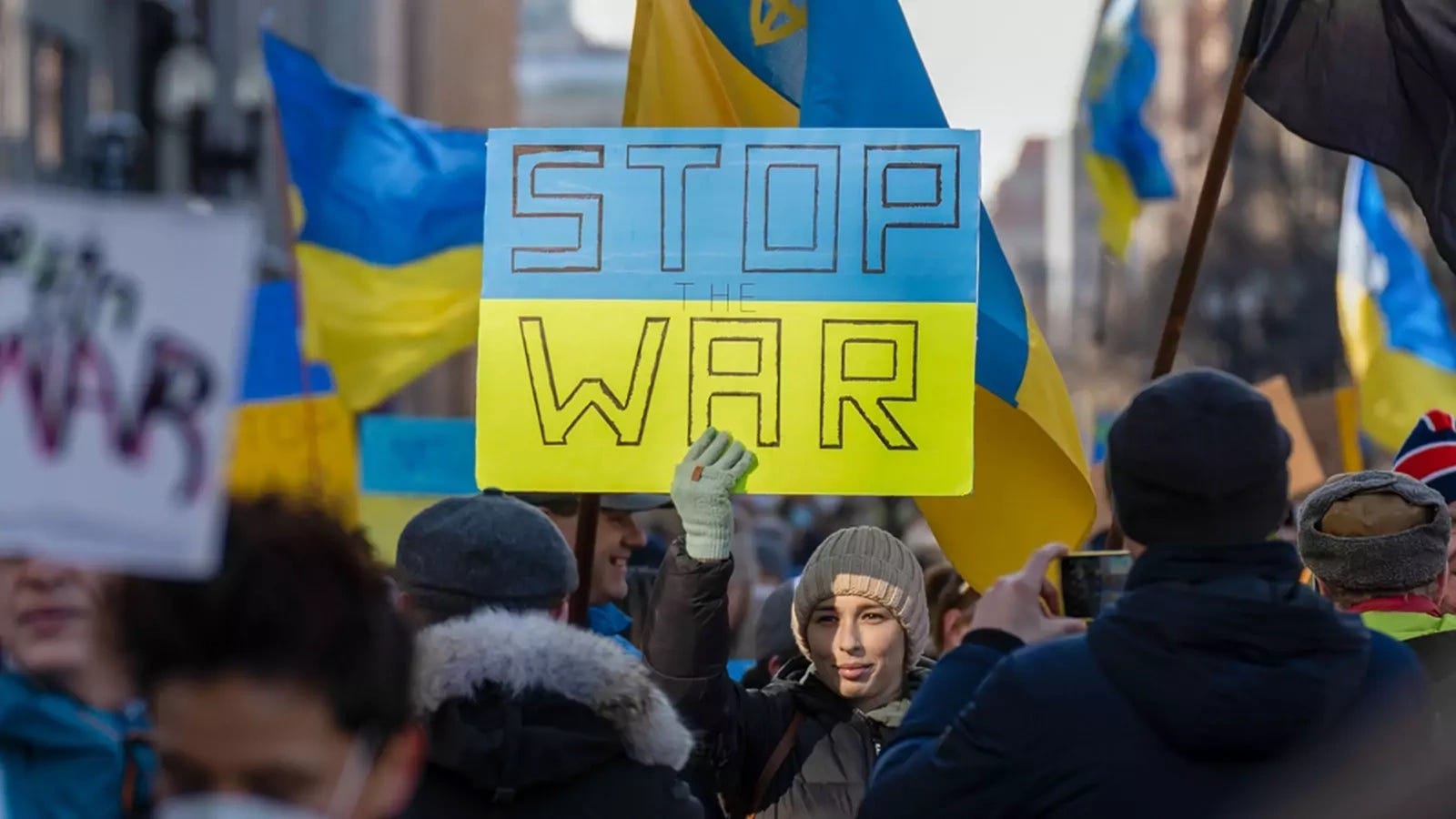
The billionaire cage fight match between Zuck and the Other Guy had nothing, it turns out, on reality. Today, there’s a coup? A “mutiny,” as Putin calls it? Unfolding in Russia — dramatically so.
What does all this mean? Where’s it going? Now. I’m not going to talk to you in the terms of a military strategist, which I’m not. But I am going to speak to you as a political economist. And the economist in me? He sees the rise of a New Age of Global Conflict.
Let’s begin with what doesn’t mean. It doesn’t mean nuclear apocalypse, the world ending in mushroom clouds over Manhattan, Moscow, Paris, and London, by 3PM, tonight, uh oh, everyone, grab the nearest radiation suit and bunker down. It means nothing of the kind whatsoever.
What it does mean is that as democracy fades — maybe even dies — conflict is rising. Because these, of course, are flipsides of forms of political order. Democracy dying: we’ve talked about that a lot recently — I calculated, using public data, that democracy’s declining at the rate of 10% or so a decade, maybe more. That gives us just a few decades until there is no more democracy, or at least so little of it, we can’t speak of democracy as a significant form of global order anymore.
So: as democracy fades and withers, the flip side is that conflict is rising. Let me now make that context concrete.
Who’s really nervous today? Not just Putin — but Xi. Xi Jinping is looking at Russia, and biting his nails a little bit, or maybe a lot. Why’s that? Because Russia supplies everything that China has come to rely on, to feed the machine of globalization, which is itself breaking down. China’s manufacturing might? It depends, not just in a small way, but critically, on Russian…everything…from electricity to lumber to oil and gas and on and on. So Xi is looking at this instability in Russia, probably, and wondering: how is all this going to turn out for me?
There was a key word in that last sentence. Instability.
The way that we used to think about the world went like this. It was made famous in a book by Francis Fukuyama, called “the End of History,” and if that sounds a little bit Nietszschean, well, that’s because it was. This school of thought — which came to be later known as the “Washington Consensus” — went like this: democracy would spread around the world, as would capitalism, each supporting the other. And that was it. The final form, if you like, of political order. Ever. Period. Full stop.
Now, it’s always a little unwise for a thinker to say something is the ultimate. The apotheosis. The last, final, because it implies a kind of perfection. In the human world? Nothing’s perfect. And it turned out that this hypothesis? Well, it was one of the wrongest in history.
Democracy and liberalization and capitalism didn’t turn out to be the “end of history.” Not even in the very place that fervently wished for all this, which was, of course, Washington DC. Just a couple of decades after Fukuyama’s thesis triumphantly echoed through the broad DC Avenues — what happened? Trumpism happened — and America was downgraded from a full democracy, to a flawed one.
And then Trump attempted to lead his mob — made of paramilitaries — to storm Congress. Sound familiar? Isn’t it a kind of echo of Wagner storming Moscow, or at least trying to? You might not think so, and Trumpists surely won’t — but of course in objective terms, here we have examples of a kind: coup attempts. Sure, there are important differences — America’s not as flawed a democracy as Russia, which is basically an autocracy, add all the caveats you like.
All that’s the New Age of Global Conflict. Of course, Russia’s bloody and illegal war in Ukraine is the most visible example. But examples abound, and another one — maybe a far more telling one — was Jan 6th, the storming of Congress, because that was the day, really, that the “End of History” as the inevitable triumph of democracy died for real, at least as a kind of intellectual hypothesis we could take seriously anymore. Even in DC, blood rolled down the steps of the Capitol. Global conflict. Democracy versus…
Violence, brutality, ignorance, stupidity, hate, disinformation, misinformation, mistrust, hostility, rage, aggression. And isn’t that what permeates our societies more and more everyday? The New Age of Global Conflict isn’t just something “out there,” far removed from us. It’s something we’re all living, every day, whether we really want to admit it or not. Think of the way that a meteorologist was recently intimidated off the air by fanatics for…talking about…climate change…which was met with death threats…that gave him PTSD. PTSD was initially discovered on battlefields. It’s literally what psychology invented as the formal name for what used to be called, after World War I, “shellshocked.” Everyday meteorologists shouldn’t get that, just for doing their jobs. But now they do.
In a sense, more and more of us are soldiers now, in this Age of Global Conflict, and that is why life feels so wearisome, sinister, anxiety-ridden, and downright creepy. Don’t take that literally. I don’t mean we’re putting on uniforms. What I mean is that norms are changing. Peace, tolerance, coexistence — people just willing to listen to facts, reason, gain knowledge — are being replaced by outright violence, intimidation, fear, hate, and rage. And for the sane and thoughtful among us, that leaves us baffled and bewildered. We get traumatized by all this, and we don’t even know why. It’s because conflict — very real conflict, to the point of PTSD, death threats, intimidation, all the rest of it — now surrounds us, for…anything, a tiny thing, just doing your job.
That’s the micro-picture, and maybe it doesn’t help you understand what I really mean, so let me continue.
Keep reading with a 7-day free trial
Subscribe to HAVENS to keep reading this post and get 7 days of free access to the full post archives.