
(Why) The Death of the NHS Is a Parable of Civilizational Collapse
How Painfully Stupid Do You Have to Be to Give Up…An NHS? Welcome to the Future.
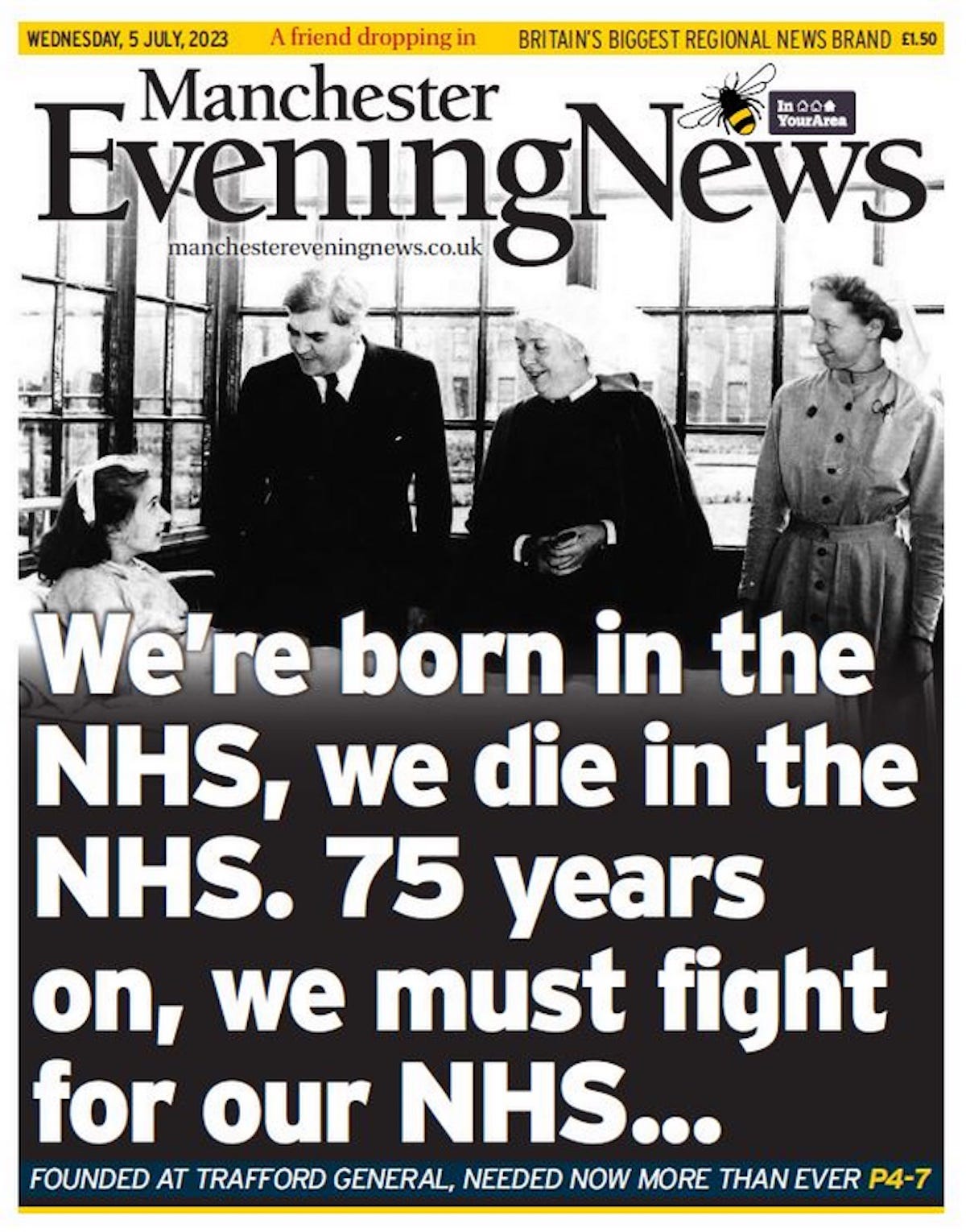
It’s the 75th birthday of Britain’s NHS. It’s also looking a lot like the last days of Britain’s NHS. One of the modern world’s great institutions. Will it last another 75 years? Not in the way we’ve known it, certainly — universal healthcare, for all, all of it. The NHS might not matter to you — you’re American, European, Asian — and yet it’s an example of something we’re all losing. A future.
I mean that in concrete, hard ways. The remarkable birth — and sudden, stupid, foolish, desperate death of NHS — tells the story of an age that’s dawning. A wrong one, a backwards one. We should be expanding systems and institutions which care for us — but slowly, instead, they appear to be dying off. Tomorrow, our grandkids will probably ask us, bewildered, in awe: “there was a world where you could…see a doctor…just like that? Where everyone was taken care of?”
Extinction. They’ll ask us the same thing about, of course, the natural world. “Mom, what was a whale?” Or: “Dad, what did a forest used to be?” They’ll be living on a very different planet — one where just going outside and breathing clean air, drinking clean air, having fresh food is going to be a luxury reserved for a very, very wealthy, lucky, or foresighted few. But they’ll say the same thing — ask the same questions — about the institutional world. They’ll find it remarkable that there used to be a world of systems and institutions at all — now just a free-for-all, where it was every person for themselves, trying desperately to figure out how to eke out a life on a dying planet.
Maybe you think I exaggerate. Very good. The death of the NHS is an example. Just one. Let me give you an even bigger one. The World Bank. What’s that? It was set up, like the NHS, after the last World War. It’s goal was something like the NHS — a better future. But think of the scale of the ideas involved then. The NHS: to end preventable sickness, disease, and ill health. The World Bank: to end poverty, hunger, and war.
Those were goals heretofore unprecedented in human history. Just think — really think — for a moment of how bold and big — and beautiful — they were. Imagine going back in time, and meeting a Roman, a Gaul, an ancient Egyptian. And you tell them that here, in the future, we’ve created great institutions, whose purpose, raison d-etre, job, it is to end these old plagues, these blights upon humankind. From sickness to hunger to war.
Their jaws would probably drop. How could such a thing be possible, they might wonder. Forget the technology — this is a tech-obsessed age, but technology isn’t the story of human progress, really. Institutions are. If you doubt me, consider that it took World War for humankind to create institutions dedicated to ending its great curses and blights, once and for all. That was a choice that could have been made at any point in history, independent of technology — technology gives us the means, the tools, but vision, imagination, purpose, meaning? That’s something else entirely. It took us 300,000 years of human history to get that far, to discover that level of…? What shall we call it? Civilization.
Keep reading with a 7-day free trial
Subscribe to HAVENS to keep reading this post and get 7 days of free access to the full post archives.