
Why is America the Rich World’s Most Extremely Violent Society?
The Unique Problem of Extreme American Violence
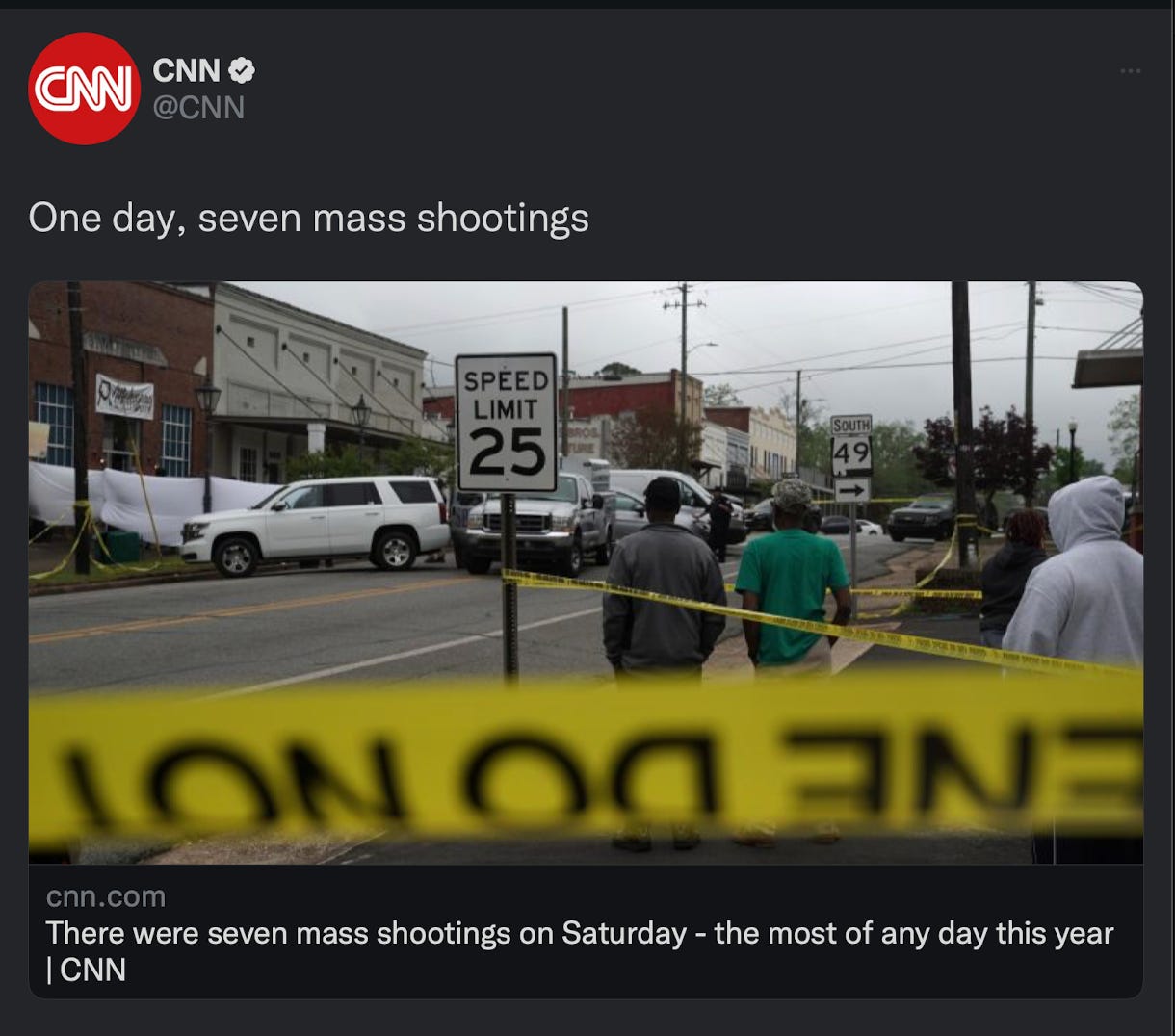
There were seven mass shootings on Saturday.
A park shooting in Kentucky, in a community still processing a bank shooting. Two dead.
A Sweet Sixteen birthday party in Alabama. Four dead, 28 injured.
Meanwhile, at the NRA leadership forum this same weekend, Governor Kristi Noem boasted that her two year old grandkid “already has a shotgun and she already has a rifle.”
Grotesque.
The numbers are horrific beyond belief. Guns are now the number one cause of death for children. On average, 12 children die of gun violence a day. Over the last three years, America has had on average about two mass shootings a day. Yet they’re not really the uniquely and singularly gruesome American phenomenon — violence itself is.
Did you know that America isn’t just the most violent nation in the industrialized world — but an off the charts extreme outlier? Iceland is the world’s most peaceful society. Canada is the world’s 12th most peaceful society. America is the… 129th.
You could even argue that America’s one of the world’s most violent societies, period, rich or poor. It’s 129 out of 163 — of which the last thirty or so are barely hanging on as societies. It’s developed unique and weird forms of soft and hard violence, from school shootings, to older Americans choosing between healthcare and food, to people dying of a lack of insulin or basic medicine. Meanwhile, murder, domestic violence, extremism, hate crimes, systemic harassment and abuse against women, are often at, sometimes beyond, developing country levels.
The question is: why is such extreme violence normal in America? Not just at the level of laws or norms — but for what deeper reason America seems not to ever developed nonviolent ones.
Here’s a small observation.
Just one. That is all it takes to scar a society for life elsewhere.
Polytechnique. That is all you have to say in Montreal. Everyone will know what you mean. When a misogynistic gunman shot up a school in Quebec, it became a dark part and essential part of the history of that beautiful and gentle province. Denis Villeneuve memorialized in the haunting Polytechnique.
Breivik. That is all you have to say in Scandinavia. Today, after a long period of trauma, it is dealing with the wounds left behind. But only perhaps. Because they are still raw. It is still debated. How could we have allowed this to happen? What did we ourselves do wrong to fail our children thus?
What would happen in other rich societies if extreme violence, like almost two mass shootings a day, became some kind of gruesome norm? I can all but guarantee you that people would march down to their capitols, simply remove their government, and install a better one. Their kids being massacred? It would be done democratically and peacefully. But there is no doubt that even a week’s worth of school shooting would cause something like a revolution almost everywhere elsewhere. Just one school shooting is all it takes to scar such societies for life, after all.
And yet. In America, extreme violence does not appear to really impel people to the point of change. Perhaps you will dispute that. It wounds the families they affect. We grieve with them for a day or two. But extreme violence does not seem to motivate Americans as it does the Quebecois, Scandinavians, Australians, British. Americans may shout and moan and shake their fists digitally. But they are not moved enough to effect social, cultural, or political change.
Am I simply saying “take back the government?” No. First I want us to go on understanding ourselves a little.
Why aren’t Americans moved like other societies are? Let us consider the possibilities. Perhaps Americans are overwhelmed with the sheer amount of violence. They have, in other words, become inured and habituated to atrocity. When you look at the numbers, it’s very clear American kids — and American people — are fighting a war by any other name. Against themselves. Thousands of people dead in a year — for ideological reasons? What else do you call such a thing? But what is being overwhelmed, then?
Americans prize a self-image of themselves as Stoics — compared to emotional Francophones, or depressive Northeners. But this self-image has a downside, too. Their attention span is measured in hours. It isn’t a week before they’ve forgotten whatever latest scandal is put before us. In America, we forget. We go on.
Keep reading with a 7-day free trial
Subscribe to HAVENS to keep reading this post and get 7 days of free access to the full post archives.