
Why Even America’s Rich Feel Poor
Why Earning a Small Fortune Doesn’t Make You Feel Rich-Rich in America Anymore
There’s a conversation which takes place between my American and European friends. Predictably, so much so, that it’s become a regular kind of event. There we are, having a nice lunch, or dinner, or what have you, and inevitably the subject of money comes up. My American friends, the well-to-do ones, say something like: “We’re making 200K a year!” Or “300K a year!” They hold their heads in their hands in despair. My European friends look on, baffled. They look at me, as if to ask…”but why are they depressed about being rich?”
And then I have to explain. In America, even rich Americans feel poor.
Now. That was the subject of a couple of articles recently, which did the rounds, and rightly so, because to the entire rest of the world, even the rich, developed world, this is a baffling, bizarre phenomenon. How can you feel poor on…half a million dollars a year? That’s a shockingly high income in a world where the median income isn’t even ten thousand dollars a year…and yet, it’s true. There are Americans who feel poor on these relatively gigantic, outsized incomes.
It’s not just a feeling, really, either. It’s a reality. Let me give you a couple of example, from amongst my own friends. The doctor and the software engineer — combined income probably around the 400K mark — who had to leave the city they grew up in because they… couldn’t afford to live there anymore. The lawyer and the journalist — coming in at a little less, maybe around 300K a year — who compare themselves to their solidly middle class parents, and find their lives wanting. It’s not just a feeling — it’s a reality.
And that beggars belief. It provokes mockery and scorn and contempt. LOL, you feel poor when you’re earning a fortune? Give me a break. But in America, such a thing is becoming true.
This is the emergence of a new social class — the rich-poor, if you like, which is a little clumsy, because no, they’re not poor. They feel that way, though, because at the end of the day, like everyone else, they’re unable to save, live paycheck to paycheck, and feel a terrible sense of precarity, that everything they’ve built could disappear overnight. Like, say, in this round of already savage tech layoffs.
The rich-poor display many of the same behaviors that, yes, we associate with poverty. Us economists, anyways. They can’t put money in the bank. They end up living off debt. They’re not really rich-rich — until, maybe, the end of their lives, if they’re lucky enough to win this “sorting game,” another bit of jargon, which basically means contest. If they make it that far without layoffs, without interruptions to their trajectory of earning these outsized amounts — which is pretty rare — then, sure, they might end up with homes and cars paid off and kids educated to a high standard and a little bit, maybe to retire on. But if they don’t, which is more often the case? If layoffs strike, or some other calamity — medical, a bad investment, a personal slip-up, a divorce — hits? Kiss it goodbye. So like the poor-poor, the rich-poor are really trapped by their circumstances.
Easy enough to scorn, harder to understand, so let me give you an example, from another couple of friends. The high-flying “hedge fund manager” who…lost that plum job…wham, suddenly, out of nowhere…had to reveal that his opulent life calculated to impress was had on mega-debt…and move his young family back home with his parents. The other high-flying executive of a company which is a household name, who’d just spent a small fortune designing a “forever home”…on which the construction was just beginning..and wham, layoffs hit. So much for the home. He had to move into a smaller place, not a bigger one. So it goes. And when you understand that about this class, you also begin to understand that those outsized earnings are insurance policies, of a sort, because you don’t often earn them for long enough, steadily enough, to accumulate that much real wealth, which is why this class is in a kind of perpetual despair, doing this seemingly bizarre and scornful thing of crying over earning…that…much money.
So. I’ve explained this class a little bit. But how can it exist? Well, the answer to that question usually goes like this: cities have become disproportionately expensive, and so living in places where these jobs exist also costs a very great deal. True, but there’s an even truer truth at work here.
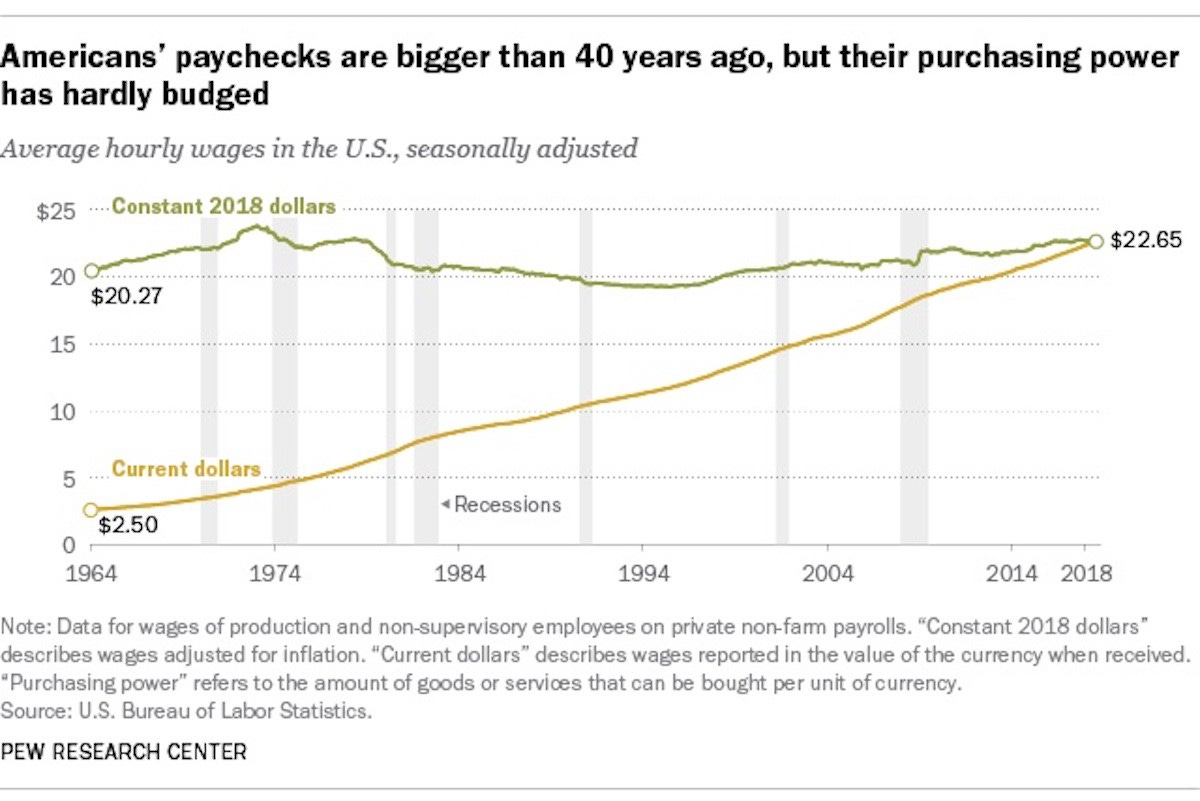
Life in America’s become fearsomely expensive. It used to be the case, not so long ago, that European life was expensive — quite a bit more — than American life. But now? The opposite is true, in a kind of eye-popping way. Feeding a family on, say, ten bucks in America? Even twenty? Pretty hard to do, unless you want to eat rice and beans, and there’s nothing wrong with that, but, well, the kids might complain after a while. In Europe? Easy. You might have to be frugal, but it’s not exactly a huge problem. Simple things like this in America cost far, far more than they do in Europe. Another simple example’s connectivity. In America? North of a hundred dollars a month, maybe closer to two, for internet and TV. In Europe? Not even half that. In other words, American life — just the basics — costs twice as much.
But we’ve barely begun. Why are the rich-poor, well, effectively always impoverished…just like everyone else? The real answer to that question has to do with the basics. What do we really need in life — modern life? We’ve covered one basic, which is food. Then you’ve got healthcare, housing, and education, to name a Big Three, if you like.
And in America? The Big Three — you can add to that list as you see fit — are astronomically more expensive than, well, anywhere on planet earth. Housing? There’s plenty of it in Europe, which is relatively affordable, and while even Europeans complain about prices in major cities, in America, second cities are becoming more expensive than European first ones. Healthcare? LOL — only in America do you get crazy, insane, million dollar medical bills, and yes, that actually happens. Even if you have “insurance,” you’re not getting off lightly — still spending thousands, maybe tens, even hundreds, on basic medical care in the 21st century. Then there’s education. Want to educate a kid well? In Europe, in most of the rest of the world, university doesn’t cost what it does in America. European students enjoy affordable education at mostly fixed prices, whereas in America, a university of repute will set you back sums that makes the world shudder and weep.
Now. Some of those things aren’t strictly necessities in the “you die without them sense,” particularly the “your kid has to go to a really good university.” And yet in America, make no mistake, it’s a huge, huge boon to a kid’s survival if they do — which it shouldn’t be, the brand name of a university shouldn’t mean much — and survival in America really is that: cutthroat, existential.
Keep reading with a 7-day free trial
Subscribe to HAVENS to keep reading this post and get 7 days of free access to the full post archives.