
Why Are Things Getting This Bad, This Fast?
A Crash Course in the Incredibly Depressing Economics of Climate Change
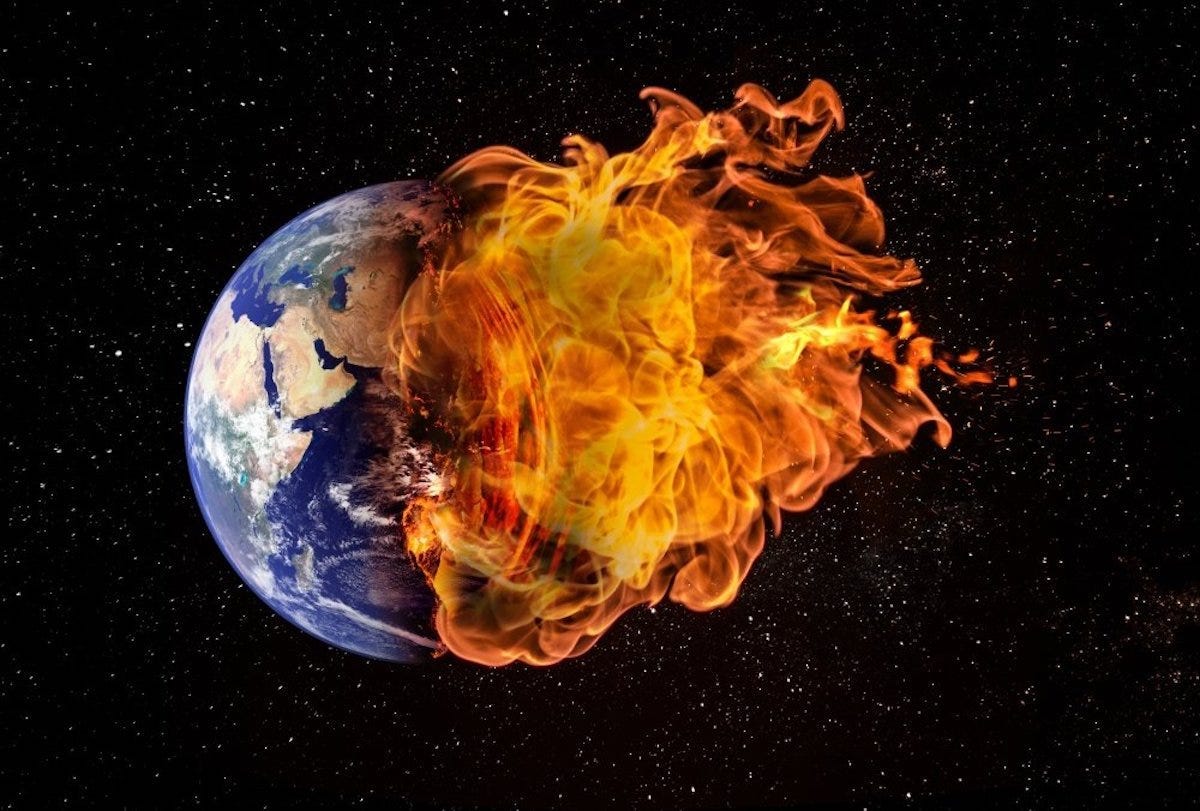
Extinction summer. Four great heat domes stretch across the globe. The planet, they say, is burning, and the oceans boiling. And people are startled, shocked, and bewildered. This fast? This hard? Climate change used to be an abstraction, a theory — now it’s become, all too suddenly, a devastating everyday reality.
And in that way, it’s beginning, at last, to enter humanity’s collective consciousness — overdue, but better late than never. As it does, a fierce debate’s breaking out. Just how bad are things? Are we “doomed”? Or hey, wait, maybe climate change will make us better off, says one side, almost laughably, as mega-scale impacts from fire to flood wreak havoc across the globe. How does the average person make sense of this?
One thing I often advise is to learn the climatic basics — climate tipping points, what they are, which ones are being hit, what earth’s great systems are, and how they’re destabilizing. But on a civilizational scale, even all of that’s secondary to what we’re going discuss today: the economics of climate change, which are the best way, if you ask me, to answer the question: how doomed are we?
If I was going to teach a freshman course on the economics of climate change it’d go like this. We wouldn’t start with the complicated, abstruse stuff — which we’ll come to in a moment — but a really simple Big Picture view.
Why is climate change getting worse, this hard, this fast? Because our civilization looks like this.
So far, we are seeing only around 630 billion dollars a year in climate finance across the whole world — with only a fraction going to developing countries.
That’s not me speaking, that’s the IMF — the world’s authority on figures like this.
Why is that…bad?
The growing impact of global warming reminds us of the urgency. From heatwaves in Europe and wildfires in North America, to droughts in Africa and floods in Asia: last year saw climate disasters on all five continents. The effects of climate change are all around us. Without decisive action, things are set to get worse because we are clearly not on the right trajectory for cutting global emissions.
How much should we be investing? We’ll come back to that, but for now:
Financing needed to meet adaptation and mitigation goals are estimated at trillions of US dollars annually until 2050.
Now. That’s only a small part of the Big Picture. Economics is simple enough. On the one side, we have benefits — investment — and on the other, costs. So what are the costs of climate change?
Climate-related disasters have cost the world $650 billion over the last three years.
That’s from Morgan Stanley. And it’s from 2018. Let’s treat that as a lower bound. An upper bound? Here’s a paperconcluding:
The top five emitters (the United States, China, Russia, Brazil, and India) have collectively caused US$6 trillion in income losses from warming since 1990.
Here we have a spectrum. A wide one. And that itself tell us something. We don’t have an authoritative estimate of how much climate change is really costing — because by now, the costs are becoming, well, hard to count. How much do Canada’s coast-to-coast wildfires cost? What about their effect on air quality in the US — which impacts everything from work to recreation to people’s health? How much marine life did we just lose in those off-the-charts ocean heatwaves? What about the flooding that’s roared across the globe? The summer’s not even over yet. The costs are mounting faster than we count them.
Keep reading with a 7-day free trial
Subscribe to HAVENS to keep reading this post and get 7 days of free access to the full post archives.