
Why America’s Such an Unhappy Society — And How It Paved the Way for Collapse
Why I Think of Happiness as the Mother Public Good, Or the Key to a Functioning Society
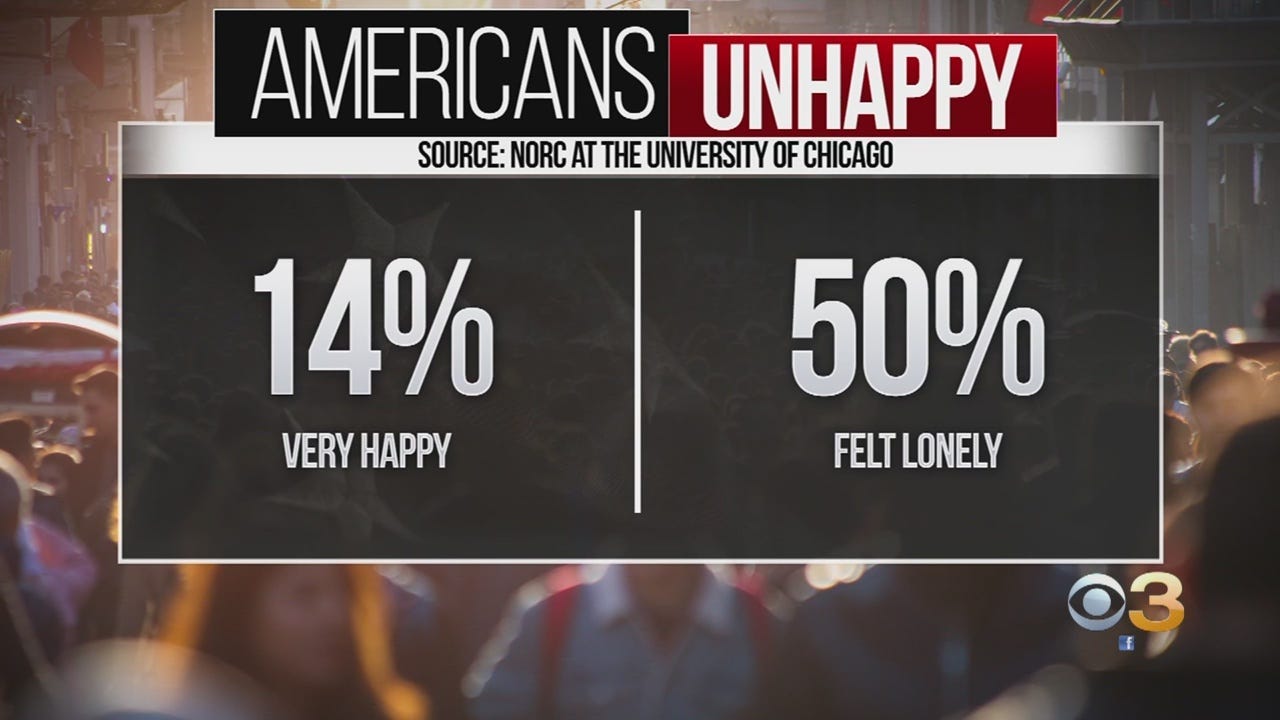
We’re going to talk about…a lot of things today. But mostly happiness. And the lack of it. How it affects a society, by affecting people. Where it comes from, and why the search for it — in America — often seems so frustrating and futile and fruitless.
I’ve been back in the States for a couple of weeks. And leaving aside the dystopia the GOP’s fast trying to turn it into — I noticed something. A thing that I always notice, but that strikes me more and more, as I get older. We live a split life. Sometimes Europe, sometimes America. And when Europeans ask me what American life is like, I say: “it’s easy. You drive your big car to the big store and buy big stuff and take it back to your big house.” They laugh. They know I’m half kidding. I’m leaving out the guns and cruelty and lack of healthcare. They don’t know, at least a lot of them, the other part I leave out.
My time back in the States tends to go the same way. I enjoy it. A lot. At first. And then I start to feel…shaky. And for a long time, I couldn’t say why. But now I know why. There’s a part of my life in Europe that’s just…missing…in America. That can’t be replicated, really, because, well, America’s not like that.
And that’s the part where happiness comes from.
I’m a creature of routine and habit. I wake up, go to the same cafe, have a coffee, think, come home, write, make music, spend time with my loved ones, have another coffee, think some more, write, make music, sleep. My days go like that. But between Europe and America, somehow, they’re completely different.
In America? I can do all that, and not talk to a single soul, should I so choose. I can do it for days, weeks, months, without talking to a single human being. Outside of a work context, really. But in Europe? LOL. Things couldn’t be more different. Let me tell you how it goes, and this is very real.
I leave the house. I can’t go twenty feet without someone shouting my name. Hey, Umair! It’s the old gay couple who lives around the corner. How are you guys, I shout back, over the roar of a bus and a scooter. Me and Snowy walk on. He sees one of his buddies. This is twenty feet later. They squeal in excitement, and I’m talking to Karina, little June’s mom, about her new job. We walk on, and thirty feet later, it’s my new friend Jane, who works at the cafe I’m going to, and she’s going to sing on one of my songs, because she’s an aspiring singer. Another fifty feet. An elderly lady swoons over little Snowy. Gets misty eyed. Tells me about the dogs she’s had. We stand there talking, and I get a little emotional, too.
Half an hour’s gone by. We finally make it to the cafe, which is five minutes up the street. And there, the whole thing starts over. The crew working at the cafe says Snowy! They pet him and he grins up at them. He begins to boop random people — it’s his favorite thing — and they lean down and say hi. Plenty of us begin. There’s a girl there who’s moving over from America, a young distinguished scholar, and we make quick friends. The couple we see every other day is there, and we talk about what’s new in the neighborhood.
An hour’s gone by. And I’ve barely had my coffee and begun to have my thinking time. LOL. In America? None of this happens. Everyone walks on by, in stony silence. It’s rare, unusual, to have many social encounters at all. Everyone’s busy, harried, their minds occupied, and to just randomly stop and talk to someone — it’s a little weird. That’s not the social norm. So in America, what takes me an hour in Europe takes me…five minutes.
Efficiency. Ameria’s famous for it. But that’s not a good thing. Now, way back when, all this would irritate me a little. I was scared of it. I’m an introvert, one of the world’s biggest introverts. Talking to people exhausts me in some strange emotional way, even for a few minutes. And so I’d think to myself: this is a little nuts. But now? I understand it very, very differently.
My happiness levels rise because of the way life is in my little neighborhood in Europe. They rise dramatically. It’s not a small thing. It’s a big one. In America? I go a couple of weeks without this intense level of daily sociality — and I begin to feel shaky. I start having panic attacks. I start feeling lost. Sure, I’m safe in my introverted bubble — but something’s missing. The intense sociality of my European life.
Where does happiness come from? Right there. You see, in America, the quest for happiness? Well, it’s become a multi-multi-billion dollar business. Bestsellers discuss it. Gurus and pundits preach it. Systems and methods abound. But America’s still a profoundly unhappy place, and it’s been getting unhappier since before the pandemic. That’s not just because systems and institutions have failed — I’ll come back to that — it’s because sociality itself is missing in America.
I don’t mean entirely missing. There are places, sure, where you can live a kind of almost European life, which is intensely social. But they’re the exception. Not the rule. American social norms are completely different, and you don’t really get this until you’ve lived outside America. How…normal…it is…to know everyone. Or how abnormal…yet normalized…it is…in America, at least…to pretend you don’t know people you see every single day. I go to the cafe in America? They still pretend they don’t me. It’s been years. LOL. You know what I mean. And at a Starbucks or what have you? The problem’s worse, because of course American life is free-floating, semi-random, defined by capitalism. Next job, move on. People don’t get to know each other. Community doesn’t get built.
Keep reading with a 7-day free trial
Subscribe to HAVENS to keep reading this post and get 7 days of free access to the full post archives.