
What Will the 2020s Be Like? Welcome to the Great Contraction
Our Civilization’s Going into Decline, It’s Going to Be Painful, and It’s Up to Us to Reverse It

By now you probably want to know: what kind of year is 2023 going to be? And the rest of the 2020s — what are they going to be like? You have a certain uncomfortable feeling in the pit of your stomach, probably. Like when you go to the doctor, and you know something’s wrong. Don’t worry. I’m not the doctor, and you already know: things have changed. It’s not going back to the way it was going to be “before.” Before what? I’ll come to that. First, though.
The 2020s are going to be what history will later remember as a Great Contraction. And 2023 is going to be its Big Crunch. Those timeframes can even be expanded, because in the grand scheme of things, the 2020s, 30s, 40s are going to be what history remembers as a Great Contraction. The 2020s will be its Big Crunch.
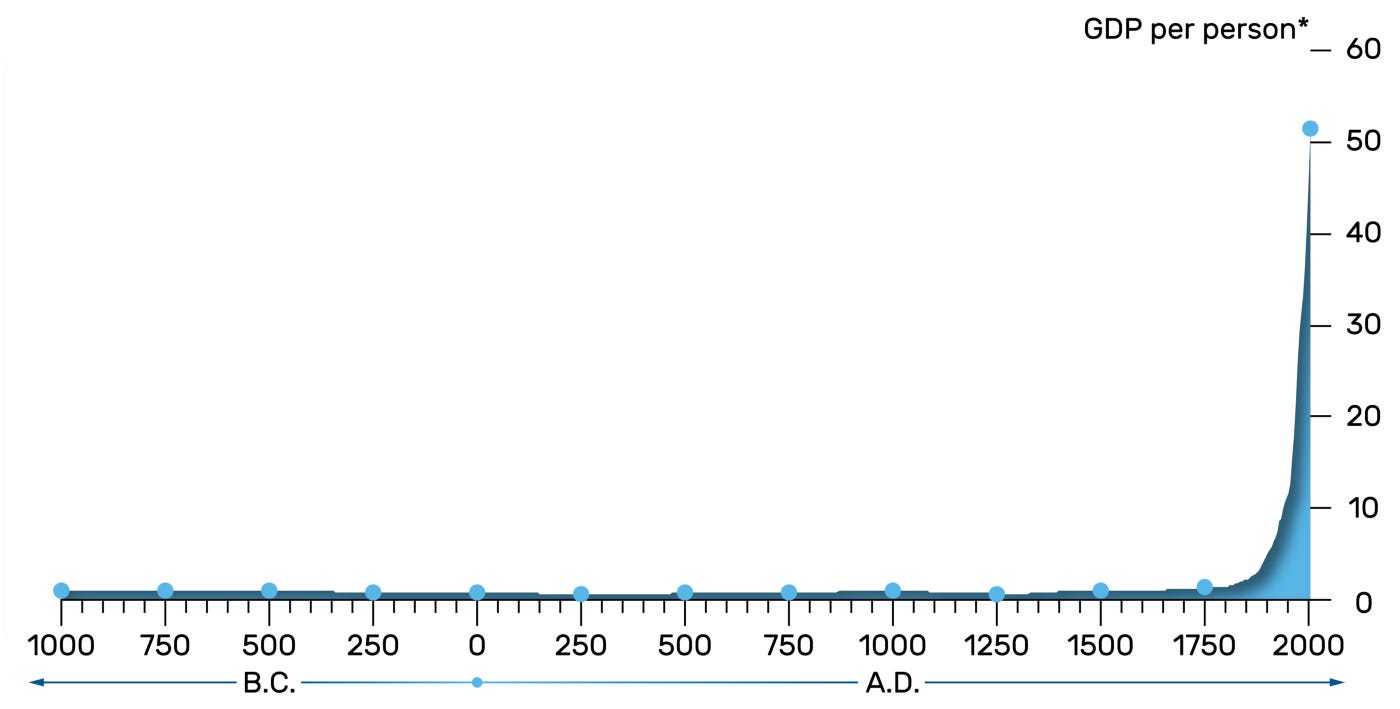
What do I mean by that? Something very simple, and very lethal. Our civilization’s living standards are now going to contract. For the first time in a very long time. How long? Well, they began to explode at the dawn of the Industrial Revolution. And now is the first time since then that they’re falling, and going to continue to fall, in dramatic ways.
Let me give you two examples. They’re not really examples, though — I’m going to use the two biggest indicators any civilization has or can have: longevity and incomes. Right now? Our civilization is seeing falling longevity and falling real incomes. In tandem. For the first time in centuries.
If that gave you a sudden chill down the spine, it should. You intuitively understood that one of these indicators alone could perhaps be explained away as just a hiccup, or a tremor, or an accident. But not both.
To see a civilization’s longevity and incomes begin to fall is frightening. It doesn’t just portend worse to come, because such trends hardly magically reverse themselves — it points, more deeply, to something having gone seriously wrong with the very basics of that civilization, that it’s now facing elemental, fundamental challenges. What else does it mean when, suddenly, people are living shorter lives, and getting poorer? Such a civilization must be struggling, suddenly, in some serious and profound way — hitting limits, constraints of a hard kind, facing shocks it’s never seen before.
Think about it, and really examine it. Incomes rose for centuries. The Industrial Revolution brought with it a now famous explosion in prosperity. No, those gains weren’t equally distributed — it was only in the 20th century that the world really made progress on that score. And yet that explosion in wealth also brought with it rising living standards. Famously, life expectancies began to rise, because now, thanks to industry, society had a surplus, for the first time, that it could reinvest — money, talent, effort, endeavor, people not having to till the fields, but become scientists and engineers and so forth — in things like research that led to miraculous breakthroughs like antibiotics and chemotherapy. So along with the explosion in income that the Industrial Revolution created, came a series of such explosions, right alongside it.
Keep reading with a 7-day free trial
Subscribe to HAVENS to keep reading this post and get 7 days of free access to the full post archives.