
What (Really) Killed Silicon Valley Bank
What Else Implodes on Dying Planets? Financial Systems, And Ours Is Beginning To
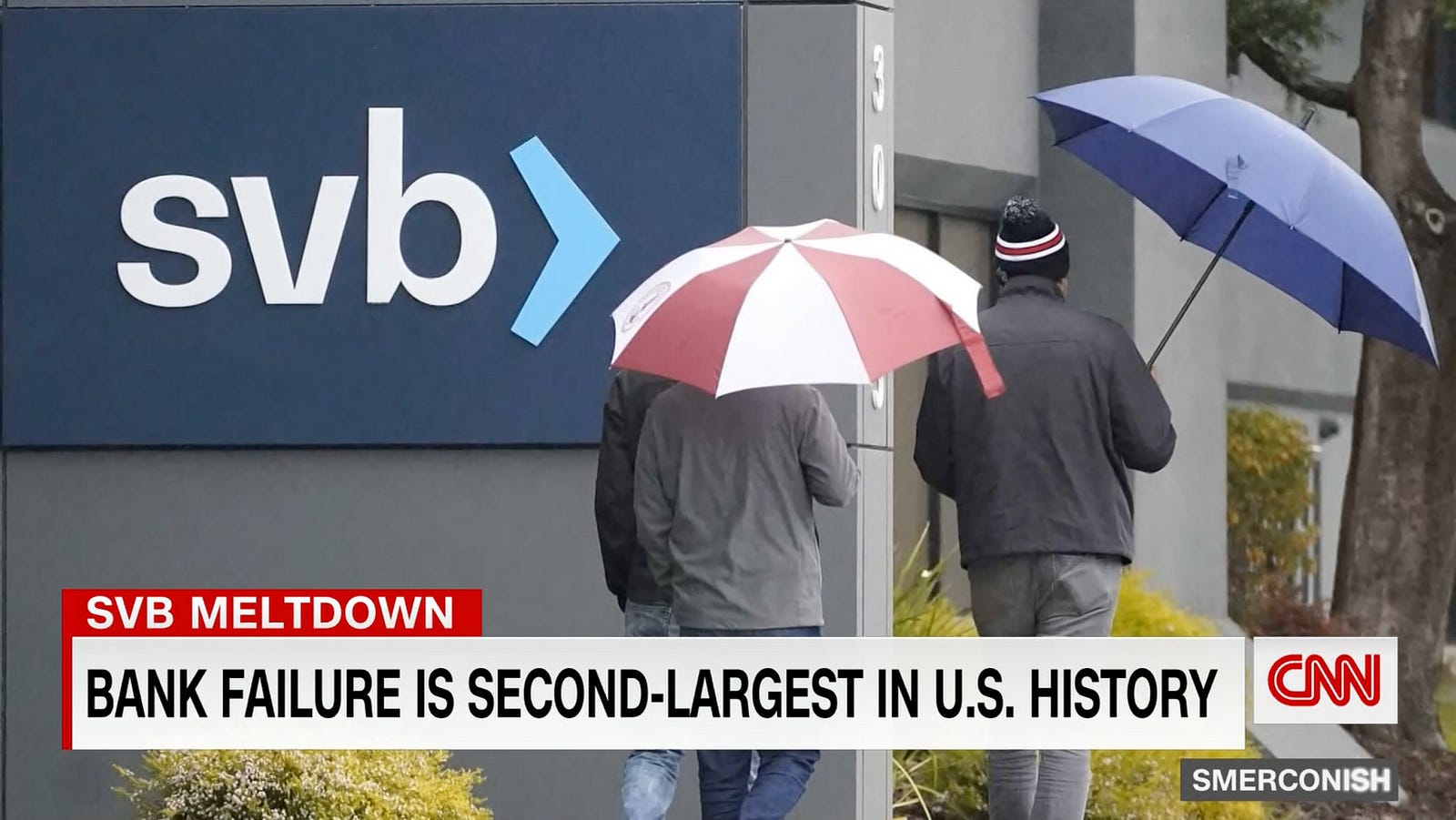
In a foxhole, everyone turns into a libertarian. It’s sad, but true. Take the example of the failure of Silicon Valley Bank. My Twitter feed filled up — fast — with erstwhile leftists and centrists and whatnot literally screaming that there shouldn’t be a bailout. Fair enough, I guess, if the logic “no safety nets for me means no safety nets for anyone!” really makes sense to you.
And this is…about as far as America’s commentary on the subject’s gone. It’s followed this tedious, predictable process, which ends in “I don’t have much so nobody deserves anything!!” But is that really the lesson to be drawn here? Is it just about…bailouts…and who deserves them?
In fact, there’s a much deeper lesson here, which is that our financial system is completely broken. It is not fit for the future. It is one of the big, big reasons that we are barely surviving the 21st century as democracies and modern societies, and the odds are pretty slim that we eke out even another few decades without hardcore implosion spreading. What do I mean by all that?
Well, let’s think about what’s actually happening in the world. Have you heard of a little thing called “climate change”? Sorry, I don’t mean to be facetious. But you see, note how totally divorced from reality the above discussion really is. Let’s try to reframe it. How are we to deal with climate change — whose mega-scale impacts are already here?
What really caused the failure of Silicon Valley Bank? Climate change did.
Silicon Valley Bank — ironically — is the first bank failure to be induced by climate change. And that should give us all pause.
I know, I know, everyone and their mother who are die-hard New York Times fans will be outraged with me for saying that, and it’s tedious, to be honest with you, but more than that, it’s foolish, for you.
Let me explain to you precisely why. What caused SVB to fail? Well, it did something shocking (I’m being sarcastic) — it invested in long-dated US government bonds. Sarcastic, because, well, those are the safest assets in the entire economy. Or at least they used to be. Even they turned out to be, well, lethally risky. Why? Because the Fed began to raise interest rates like a maniac. That causes bond prices to fall, at least longer-dated ones, and you don’t need to worry about the mathof why. What’s important to understand is the next part.
Why did the Fed suddenly begin to raise interest rates? Was it…because…suddenly wages and incomes were skyrocketing? Nope, those are falling in real terms.
The Fed raised interest rates because prices have been rising. Suddenly, in astronomical ways, in huge, huge amounts. And not just for certain things, but all the basics, from food to energy to water to medicine.
And all that stuff rose in price because of what climate change is doing to our economies already.
No, not solely. There was a complicating factor here — well, not much of one if you know a little bit about monopoly capitalism. As input prices rose, monopolies jacked up output prices — the prices you pay at the grocery store or shopping mall — even more. Why? Because they could. This was a golden opportunity to profiteer. Right about now, corporate profits are at their highest point ever. Because as climate change sends the price of basics through the roof, of course monopolies who still have control over what’s left of a dying planet’s dwindling resources will profiteer like there’s no tomorrow, since, well, there isn’t. So why bother being fair to anyone, anyways?
Now. The reason that the Fed used to give for the explosive way that prices rose was…wait for it..Covid. But Covid is over — certainly not as a public health emergency, but as one that society even bothers to acknowledge anymore. Covid is done with, in the sense of lockdowns, labour shortages, and other assorted big-league, social-scale economic impacts — and yet prices have kept right on rising. Astronomically. Every month. Every day. How much more do you spend for food every month? Any sort of basics, really? The amount just keeps going up and up and up.
There is a lesson there. Prices didn’t just begin to rise because of Covid. Sure, Covid played a role, but the fact that prices are still skyrocketing, just into oblivion, tells us that Covid cannot have been the major factor. Instead, this wave of inflation is about climate change. Suddenly, we began to hit the climate’s limits, in very real ways.
Only we’re ignoring it, or at least our power centers are. My entire field, economics? LOL, it barely even talks about it. Let’s think about it together.
Was it a mere coincidence that, for example, harvests were off by double digits from Europe to California to Africa — and prices rose across the world, for food? Was it a coincidence that rivers began to run dry, from the Colorado to the Rhone, and prices began to rise for everything made from, LOL, water, from chemicals to energy? Just another coincidence that megaweather struck, which raised risk premia for everyone from farmers to shippers to people living in suddenly precarious places like shorelines — and hey, look at that, prices rose?
Keep reading with a 7-day free trial
Subscribe to HAVENS to keep reading this post and get 7 days of free access to the full post archives.