
What Happens When Economies Go Into a Winner-Take-All Death Spiral? America 2023 Does
What the Hollywood Writers Strike Says About How Much Trouble Our Economy’s Really In
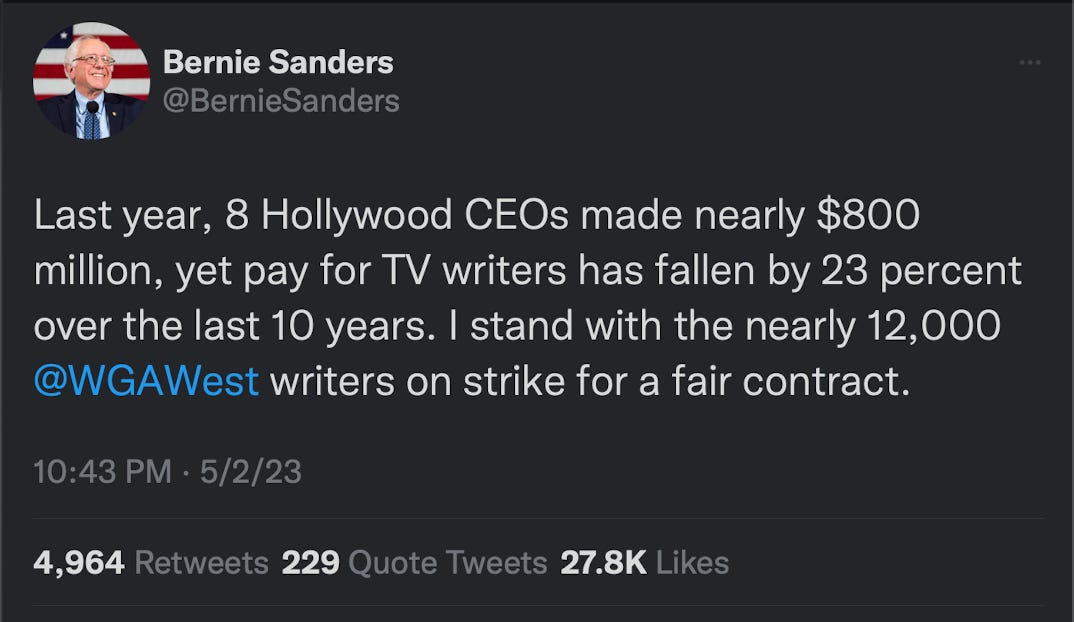
Leave it to Bernie Sanders to sum it up best. “Last year, 8 Hollywood CEOs made nearly $800 million, yet pay for TV writers has fallen by 23 percent over the last 10 years.” Ouch. That’s a concise description of the reason more than 11,000 writers are now on strike. And in America? That’s a big deal, because the Writers’ Guild is one of the few labour organizations which still functions. You don’t see a strike at this scale often, even in Europe — but especially not in America.
All of this is a perfect metaphor for where our economies are. What went wrong with them. Why they feel so…hopelessly broken. Let me begin at the beginning.
Think about what it means to have your income fall by 25% or so over a decade. Your income should grow. Over time. As you gain experience, as you gain skills, as you learn how to be more “productive,” and I’ll come back to that. But we all know — at least those of us who aren’t billionaires — that…that doesn’t really happen anymore.
What does happen? Well, what happens is exemplified by the flipside of the writers on strike — Big Tech. The dawn of streaming brought with it huge monopolies. Those huge monopolies pay…pennies…to artists, writers, musicians. This is a huge issue in music, too, where even the world’s top artists, LOL, can’t make a living off what they stream, because the monopolies have set the rates that low. Meanwhile? From Spotify to YouTube, they’re making a killing.
But even that hasn’t brought with it anything resembling job security in tech. Instead, while the writers’ strike shows the grim reality of life in our economies at the everyday level — stagnation, shrinking income — the tech industry shows the upside. And even the upside isn’t that good. Tech workers can stumble into a high-paying job, sure. But those don’t last forever, and there’s no guarantee of the kind of steady upward mobility that used to once to be the norm in a healthy economy. Instead, now? Zuck or Elon or whomever the creepy tech baron is can lay you off — snap!! — just like that. And you don’t just naturally fall into another high-paying job at another mega-firm, because, well, those layoffs come in industry-wide waves. So: high-reward, but high-risk. And the high-reward lasts for a relatively short time across a lifetime — it’s not a gentle, steady rise in earning power, which leads to savings, and so forth.
The downside? It’s bad. The upside isn’t great, either. Those tech workers then have to…LOL…try to buy or rent houses in San Francisco. So in this way, for the vast, vast majority of people, the economy is failing, and it’s failing incredibly badly. Gone are the days of work hard and get ahead. Instead, now? The economy is basically a thing of insecurity. For almost everyone.
Of course, some have it worse — much worse — than others. But even at the upper echelons? I don’t mean the CEOs and billionaires, just the average person, who’s done well. There’s still little security. It’s hard to build a life, savings, own much — and I mean really own it, as in outright, not just rent it from the bank on credit, which is better than nothing, but it’s still far from the kind of outright ownership that’s far more the norm in Europe.
Now. We may all have become a little inured to this. But let me, as your friendly neighborhood economist, point out, and assure you. When an economy only offers insecurity for everyone but CEOs and billionaires, it is a deeply, deeply unhealthy one.
Because you know what? These are all hard-working people we’re talking about. Watch much TV? I’m sure you do, we all do. Life is bleak these days, and binge-watching a show is everyone’s favorite escape. No judgment from me, I do it too. So if all those hard-working people are making things that the rest of us need — and yes, we do need things like a vibrant culture, just as much as food and water, unless you like living in, say, Afghanistan these days — why can’t they make ends meet? You see, there’s something wrong with this set of outcomes, and I mean both at moral and economic levels: they’re making stuff we need, maybe more than ever, given the political and social climate — and yet their incomes are falling. They’re making stuff for which demand is higher than it’s ever been — and yet their incomes are falling.
And then there’s the moral level, which is simply that everyone should be able to have a decent life.
So what happened here? The way that Bernie summed it up isn’t an exaggeration. It’s in fact very, very good economics.
We’ve developed what’s known as a winner-take-all economy. We’ve had one for a while. But now? It’s reached grotesque, obscene, staggering proportions. Think back to, say, the late 80s or 90s. That was the age in which everyday millionaires — the winners of the economy — started to become multimillionaires. And by the 2000s, they’d become multi-multi-millionaires. Today? 8 CEOs of Hollywood studios earn more than $800 million. A year. That’s more than $100 million each.
Meanwhile, America’s median income is a little over…LOL…$30K. That means these CEOs are earning almost 3000 times the median income. Every year.
What kind of sense…does that make? You see, there are two ways to think about this economically. One is to throw your hands up in the air, and say something like “free markets reward competition!! The most skilled earn the most!!” But…LOL…that’s not really thinking about any of this, that’s just a cop out. These aren’t free markets in any real sense of the word, they’re monopolistic ones. And it’s hard to say that said CEOs have any real skills outside of navigating the corporate world — mastering its politics, and learning how to climb the ladder. Certainly, I doubt whether they’d be able to…write a watchable show.
Keep reading with a 7-day free trial
Subscribe to HAVENS to keep reading this post and get 7 days of free access to the full post archives.