
What Do You Call a Failed State Inside a Failed State? Texas
What Do You Call a Failed State Inside a Failed State? Texas
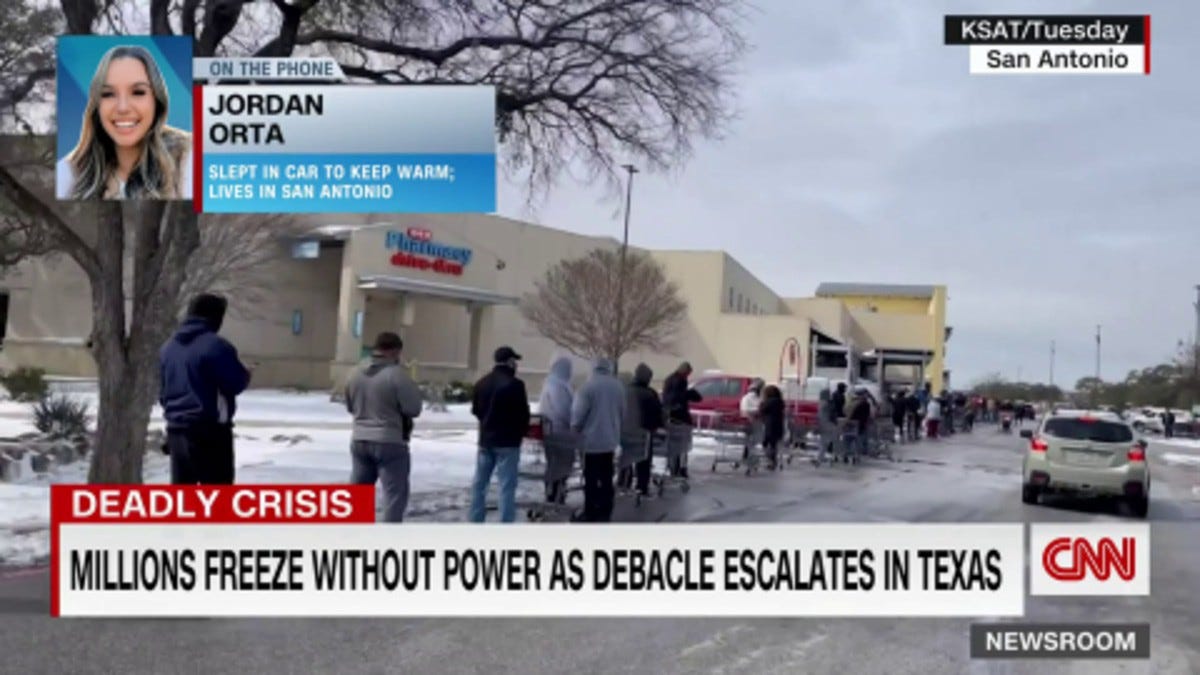
Millions without power or heat. Sub zero temperatures. Little food. Empty shelves. People burning their furniture to stay warm. It sounds like a scene from a disaster movie, but it’s just the last few days…in Texas. All that’s the result of a winter storm. And while America’s now generally accepted as a failed state, among its own states, one of the leaders in failure is Texas — as the last few horrifying days prove.
Why did all this come to pass? Note the irony for a second. Texas is America’s biggest energy producer — and there it is, without enough energy to get people safely through a winter storm. Now that’s what you call a failed state.
Texan leaders have — predictably — blamed all this on everyone and everything but themselves. They’ve trotted a litany of falsehoods. The wind turbines froze, the solar power failed, the liberals did it! Wrong, wrong, wrong. What happened in Texas was lethally simple — with tragic consequences. Yet another failure of neoliberalism — one that tells a tiny tale of the future of our civilization, and why we need to think in radically different ways now if it’s going to survive this century.
Around 2000 or so, Texas deregulated its energy market. Now, any sane economist will tell you: that’s about as foolish as handing your life savings to Bernie Madoff. Because energy is, wait for it, a natural monopoly, since one owner of all those pipes and tubes is going to emerge dominant, meaning that it’s just what it appears to be, a utility. Never mind logic, facts, reason. Texas exemplified America in the grip of a lunatic, bizarre, backwards ideology of privatisation, individualism, greed, “self-reliance,”all of which is simply summed up as: neoliberalism.
The results were depressingly predictable. Prices never fell for consumers — monopolies, remember? They were busy cashing in, on captive consumers. Worse, gigantic energy corporations did what profit-maximising concerns tend to do: underinvested in maintenance and renewal of an old, shabby energy grid. And all of that was leading to system fragility. All it was going to take was one abnormal event to hit this broken system with a KO punch.
Enter the events of last week. Snow began to fall across Texas. Temperatures plunged. And guess what, Texas’s systems snapped like twigs.Millions were left without power, in the freezing, Canadian-level cold. Water pipes burst and froze and shattered. The shelves lay bare, as people desperately stockpiled food. Texans understood what it really is to live in a failed state. And while no one should have to live like that, you shouldn’t have to live like that in one of the richest countries in the world.
Now, I don’t mean to sound callous to those who live in Texas, who do not deserve to be burning their furniture to stay warm. It’s worth remembering that this is what Texas made. Not Texans, meaning individual people — Texas, as in the state, its leaders, its institutions. Nobody else made this mess, not Mexicans, Jews, Black people, Muslims, as Trumpists in such a die-hard Red state are fond of saying. Scapegoating is not good enough here. Nobody but Texas made this mess, and this mess was completely avoidable. It should never have happened.
Every country should have systems that are strong enough to withstand extreme weather events. Snow falling or a cold snap setting in barely even count as extreme weather events, but even so, the reason is simple: they are going to become more and more common. As, of course, climate change intensifies. It’s not just a simple case of “global warming,” which is now an obsolete term, but rather extremes of all kinds intensifying. Extremes of heat, yes, but also extremes of cold. Extremes of moisture — floods, and extremes of dryness — droughts.
A functioning society needs to build systems that can withstand an age of extremification. That’s eminently not just about physical systems, like energy grids and water pipes or even food supplies. It applies to all of a society’s systems — even the soft ones.
Take the example of political and social attitudes — they’re becoming more and more extreme, too. Over the last decade, nationalism and fascism have resurged around the globe. America was wrecked by Trumpism. Britain suicidally destroyed its own future with Brexit, which has caused a sudden stop in trade and relations with the EU. India turned to Modi, who blamed Muslims for all the woes of the chosen people. Russia, of course, is home to a bombastic new authoritarianism. The list goes on.
Political and social attitudes are extremifying too. They are reaching dangerously toxic levels. Not “new” ones, per se, as America exemplifes, but maybe simply just old ones. (Remember, America was the world’s largest apartheid state until 1971, when segregation ended.) When you think about Trumpism in that context, it’s hardly an anomaly — a few decades of attempting to be a proper democracy are the anomaly.
Our soft systems, too, need to be built in order to combat extremification. Take the example of QAnon. It’s radicalising millions, whose families think of them as lost. How do we fight against extremes like that?
We have to make our hard systems resilient — fast. Or else? Or else what little civilisation there is collapses like that — snap! — in the blink of an eye. Just like it did in Texas.
And the truth is that we are not doing well on this score. Take energy, for example. We can weatherise pipes. But sustainable energy grids are still a very long way away. And “sustainable” doesn’t just mean “green,” it means: “less vulnerable to disruption from extremes.”
Food is a bigger problem. We don’t anything remotely close to a sustainable food chain — links can be knocked out like that — snap!! — as Texas’s example demonstrates. But the real fireworks are going to come when climate change intensifies to the point that global harvests fail. Then what? What happens when there isn’t enough coffee, tea, grain, sugar to go around? Who gets it? What decides? Money — or violence?
Below the level of food come the real basics. Air and water. If the last year hasn’t been a wake-up call to you, it should have been. What’s been in short supply? Clean air. Not just as in carbon-free air, but as in Covid-free air. That’s why we’re still in lockdown, most of us, and it’s been a brutal, bitter year. But Covid is just the first of many pandemics to come. And what lessons have really been learned? 80% of the globe still has no plan — or ability — to get a vaccine. That’s about six billion people, by the way. Good luck avoiding the next pandemic that way.
The point I’m trying to make is this.
We’re already at the point, as a civilization, that something as fundamental, as basic, as clean air has been in short supply over the last year. Live in a Covid-free country, aka one with breathable air? Take a deep breath of relief — most of the world doesn’t. That is because it’s systems failed to meet the challenge of a pandemic. A relatively small pandemic. Covid, as epidemiologists rightly remind us, isn’t even the big one. What happens if the next one is deadlier? What happens when Covid itself goes permanent, thanks to countries as dumb as Britain, whose carelessness bred new strainswhich are now infecting the world?
We are at breaking point as a civilization. The world’s richest country is a failed state. The biggest energy producer in that failed state is itself a failed state, which can’t supply its own people with energy. As a world, we’ve failed badly to grapple with Covid, letting it spiral out of control — as a world, we resemble America, not New Zealand, which eliminated it. We are at breaking point because our systems are not able to cope with a new age of extremification.
That is, in turn, because our systems are themselves predatory. Why is the world extremifying? There’s a very simple answer to that question, and you won’t like it. Nature is fighting back. It is trying to kill us, or at least put us in our place. To nature, we’re the most destructive, invasive species in all of history. No other living thing has created its own mass extinction — it’s taken gigantic meteors from space or mega-eruptions to do that. We’re the only biological system to have caused our very own mass extinction.
That’s because our systems are predatory. Our hard systems are textbook predatory: we feed ourselves with factory farms where living things are treated like slaves, living short, agonised lives, and then slaughtered mercilessly by machines. Our energy comes from the remains of dead things, not, say, the sunlight or the wind — which then goes on to pollute the earth and kill even more living things.
And our soft systems are predatory, too. They reflect the mindset in our hard systems — a mindset of violence, arrogance, and supremacy. Our soft systems — education, employment, social norms, culture — still lionize the “alpha male,” the dominant one, they prize values like selfishness and ruthlessness and cunning, if not outright greed. According to our soft systems, a “smart” person is one who can make a billion dollars — and send the planet, democracy, the future, and civilisation to hell. Meanwhile, my puppy isn’t a person, even though he has more social and emotional aptitude and intelligence than every preening Ivy League dork I’ve ever met.
Don’t you think there’s something wrong with all that? I do.
If I were Mother Nature, I’d want to kill us off, too. We’re just one of countless living things on this planet, and yet we abuse them all, not even for our own benefit, really — just for our entertainment, at this point. We’re so foolish and careless that, like Texas, we choose our very own ruin, thanks to short-termism and greed, and then weep about it when the bill comes due.
Do I have sympathy for the good people of Texas? Of course I do. No one should have to burn their furniture to prevent hypothermia.
But there is a very big difference between, say, the Amazon perishing, and Texas freezing in the cold. The Amazon didn’t choose that destiny. Texas did.
(No, not every Texan chose this, and that’s not what I mean. I mean that as a state, as a collective, Texas chose to deregulate its energy market, to underinvest in maintenance, in the name of neoliberal policymaking. And so here we are.)
And therein lies the parable. We’re not Gods, my friends. But we act like it. We think we can do whatever we like, and there will be no consequences. That we can outrun destiny and escape the hand of fate. That is what the Greeks would have called hubris — and reminded us that hubris always meets nemesis.
We’ve met ours. Our very own creator, Mother Nature, is trying to kill us. For our brutality, arrogance, stupidity, violence, greed, selfishness. I don’t know if that’s right or wrong. I guess that depends on your point of view I just know it is. And I know it’s a pretty bad place to be.
There’s a kind of Ivy League dork that’ll sneer: “Umair’s anthropomorphising nature!! Ha-ha!! What a dumbo!!” I’m not “anthropomorphizing nature” — you’ve learned a paradigm that stripped the life, agency, freedom, meaning, and justice out of the world, in order to give us permission to do so incredibly much violence that we’re causing a mass extinction, killing off our own planet, all because we think in a way that dehumanises all of existence. Every civilisation in human history except ours, from the Greeks to the Romans to the Incas to the aboriginal Australians, has thought that the world around us was alive, that “people” were not just human beings, but oceans, forests, animals, skies. Tell me they weren’t wiser than us.
Take a hard look at Texas, and tell me again who the foolish one is.
Umair
February 2021