
Welcome to the 21st Century. What Happens When the Water Runs Out?
Here’s a Hard Fact. Water Demand Will Exceed Supply By 40% In…Seven Years. Then What?
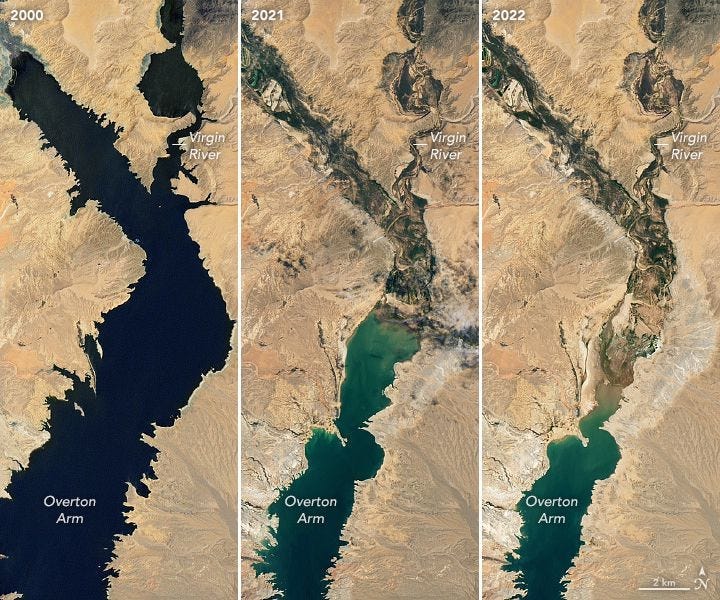
One of the themes we discuss here is an uncomfortable but necessary one. The Age of Abundance is over — and now the Age of Exinction is here. Extinction doesn’t mean we all die, the Last of Us style — but it does mean that our civilization is now at severe, critical risk. Because our most basic resources are all running out.
What’s basic? What’s more basic than food, water, energy, clean air, and medicine? Now, when I issue these warnings, and I know they’re a lot to take in, I’m sometimes accused of hyperbole or exaggeration. But I’m not kidding. You see, when you look at the statistics — the empirical state of things — well, they’re shocking.
How shocking? Here’s a screamer of a headline for you. “The world is facing an imminent water crisis, with demand expected to outstrip the supply of fresh water by 40% by the end of this decade, experts have said on the eve of a crucial UN water summit.” Did you get that? You see, these changes are happening faster than we know. Most of us don’t know the basic statistics, and when we find out, we react badly, because, well, they’re terrifying. Demand exceeding supply, by almost half. By the end of the decade. This is 2023. In the next seven years.
For…water. Think for a moment about just how…profound…this moment is. For our civilization. To history. We are the first global civilization, the first industrialized one, the first genuinely peaceful and democratic one, even in our aspirations, the first modern one. All that’s wonderful and good. But in the next seven years, we are going to run out of water.
There’s nothing more basic to life than…water. Maybe clean air, and if you haven’t figured it out by now, that’s very much under threat too, unless you enjoy getting Covid every few months, and damaging all your organs. So think about what a turning point this is to history’s eyes. Progress has flatlined and gone into reverse. We head into rough economic seas, precisely because harvests have failed and mega-weather has arrived. And now the water’s running out.
This should hardly come as a shock, though. You see, these days? We’re very, very good at forgetting. Fast. It’s a kind of survival skill. Who can even keep up with the dystopian headlines? So it was just…last summer…that rivers around the world dried up. Mighty ones, from Europe to China, from the Rhone to the Yangtze. Look around the world, and you’ll already see plenty of regions teetering on the edge of a new form of impoverishment. From the American West to Northern Mexico — one of the new buzzwords of the 21st century is going to be water poverty.
This finding — demand exceeding supply by 40% — comes from a new report by the Global Water Commission. It’s the first of its kind — and think about that, too. We think of ourselves as an advanced civilization — but we haven’t built a single functioning global system yet, not for democracy, not for education or healthcare, not even for water. So here we are, about to run out of it, and just now we’re finding out — the hard way. That’s a stunning example of underinvestment.
Let me give you some quotes from the report — which is eminently worth reading in full, or at least skimming it. Because, like I said as the first of its kind, it’s an historic document, too.
No person, place, economy or ecosystem will be spared. We are seeing the consequences not of freak events, nor of population growth and economic development, but of having mismanaged water globally for decades. As the science and evidence show, we now face a systemic crisis that is both local and global.
Whew.
We are heading for massive collective failure. The disasters of 2022 are a warning of things to come. The unprecedented floods and droughts, cyclonic storms and heat waves, in one region today and another tomorrow. The devastating toll in human suffering, and in some cases, decades of human development wiped out in weeks.
Got that? Here’s the biggie, and if you think I’m a grim read, well, take a deep breath and prepare yourself.
We now face the prospect of a 40% shortfall in freshwater supply by 2030, with severe shortages in water-constrained regions. And fundamentally, as the science and evidence show, this mismanagement of water has pushed the global water cycle out of balance for the first time in human history. We have breached the planetary boundaries for water that keep the Earth’s system safe for humanity and all life.
The bolding’s not mine, it’s theirs. Who are they? Some of the world’s top scientists in these fields. They’re not offering you their opinion, like New York Times columnists. They are telling you the facts. And the facts are unsparing.
Water is not just a casualty but also a driver of the climate crisis. Behind all carbon storage in nature, there is freshwater. Extreme water events cause an immediate loss of carbon uptake in nature. Droughts lead to fires and massive loss of biomass, carbon and biodiversity. The loss of wetlands is depleting the planet’s greatest carbon store, while the drop in soil moisture is reducing the terrestrial and forest ecosystem’s ability to sequester carbon. It risks turning these natural ecosystems into sources of greenhouse gas emissions in the years to come, with devastating consequences for the pace of global warming.
As I said, take a few moment to read the report — maybe piece by piece if you need to. It’s full of insights like the above, which we should all begin to learn, because, well, welcome to the future: it’s made of new forms of poverty. Like water poverty.
Keep reading with a 7-day free trial
Subscribe to HAVENS to keep reading this post and get 7 days of free access to the full post archives.