
TRUMP IS TAKING THE WORLD TO THE EDGE OF CATASTROPHE
WHAT HAPPENS IF THE WORLD'S ENERGY SUPPLY CRASHES AND BURNS?
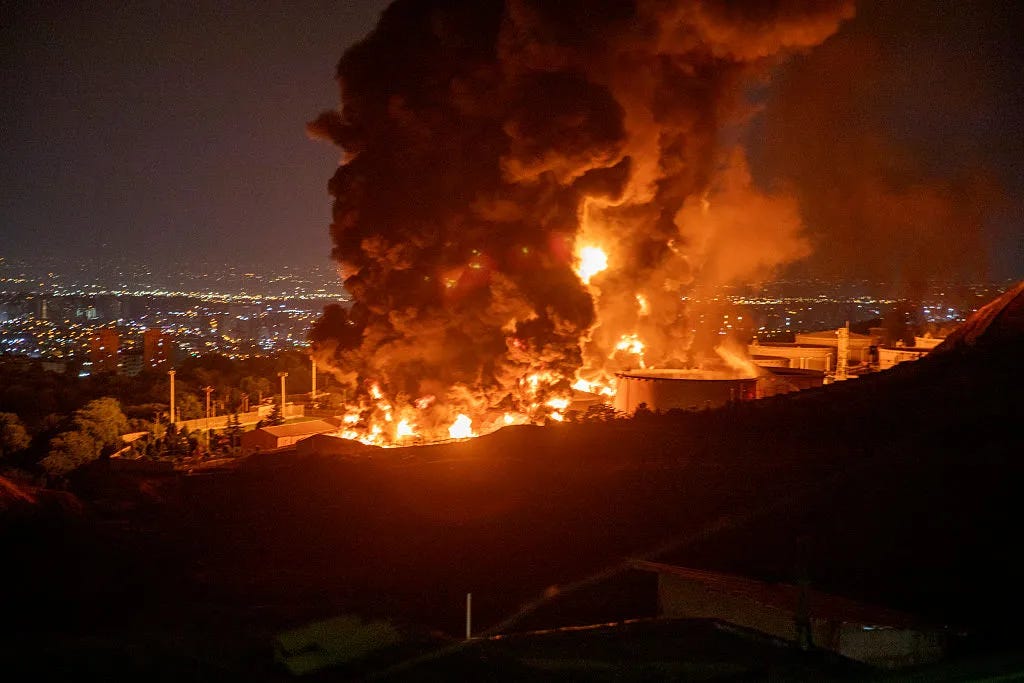
We’re now approaching the edge of true catastrophe in Trump’s foolish, reckless war on Iran. When I say “true catastrophe” I mean that civilizational risk is now at severe levels, and we face the growing probability of one of the greatest shocks in modern history—one which could make the closure of the Strait of Hormuz look like a mere childs’ play.
Let me explain. Then we’ll discuss what to do about it, investment wise.
Over the last couple of days, the following happened.
Trump issued an ultimatum, threatening to take down Iran’s energy grid in the next 48 (now 24) hours, if the Strait wasn’t “opened.” I put that in quotes because of course
Iran responded by warning it’d retaliate in kind, hitting not just energy infrastructure across the Middle East, but also, crucially desalination plants. They supply much of the region’s drinking water. Tonight, Iran appears to be walking back that threat, perhaps, but in the fog of war—who knows?
Scott Bessent finally put words to Trump’s “strategy”: “escalate to de-escalate.” We’ll discuss the sheer madness of that in a moment.
So. The clock is now ticking. Let me add one more point before I outline the three scenarios before us now.
From the FT:
“Alongside military bases, those financial entities that finance the US military budget are legitimate targets,” Mohammad Bagher Ghalibaf said in a post on X. “US treasury bonds are soaked in Iranians’ blood. Purchase them, and you purchase a strike on your HQ and assets.”
Why does that matter? It’s linked to the second point above. There are only a handful of nations foolish to have been buying American T-bills, aka Treasury Bonds, in the last year or so—and chief among them are the Middle Eastern players embroiled in this war, like the UAE, Qatar, etc. So what Iran is saying is this: even buying America’s debt is enough for us to target your infrastructure. Perhaps even including, crucially, desalination facilities.
Now. The three scenarios before us are these. Let’s begin with the first one. Iran surrenders, Trump’s ultimatum renders him victorious. Sound probable to you? Not to me. Because here we have a classic contest of strategy: tit-for-tat, escalating. And when that occurs, one side suddenly climbing down is unlikely, especially when its sides as fanatical as these.
The second scenario. Nothing much happens. Trump pretends he never issued the ultimatum, and the war just…grinds on. That’s possible, I suppose, but Trump will lose even more face than he already has, which is a big no-no for a mob boss. And the game here is clear now: escalating tit-for-tat, which by the way is a classic form in game theory, and once a game is a game, it tends to stay that way.
That brings me to the third scenario, and here’s where things get truly catastrophic. The head of the IEA, the International Energy Agency, has warned that this is already greater than the oil shock of the 1970s and Covid: he’s calling it the greatest oil shock in history. But in scenario three, it goes to another level entirely.
Trump bombs Iran’s energy grid. He sends troops to take the Strait, Kharg Island, etcetera. How does Iran respond? Exactly how it said it would. It bombs the Gulf’s energy infrastructure. Maybe even its desalination plants. And then things get very cataclysmic, very fast.
Because in this kind of scenario, the world’s oil and gas supplies begin to shut down. The Gulf nations, without energy and water, or at least under daily bombardment that constantly threatens their infrastructure for energy and water, can’t go on producing oil and gas to the same degree. Who’s going to man the facilities without drinking water or electricity?
And then we have a mega civilizational problem. The Strait of Hormuz closing down is a bottleneck. But oil and gas not being produced at scale across the Gulf because basic infrastructure’s been taken down is another level of risk entirely. A genuinely catastrophic level of civilizational risk.
What would the effects be? The closure of the Strait’s already affecting agriculture, commodities, shipping, and much more. But if oil and gas begin to go offline? Then we’re in the deepest of waters. Then it’s lights out territory, and I mean that literally. Already, nations around the world are beginning to take energy conserving measures. That’s assuming that the oil and gas will flow—eventually. But if the infrastructure’s bombed, charred, turned to rubble—then all bets are off.
Then the world is looking at a scenario it’s never really faced before. A sudden, long-term, energy shortage. Not just a short-term bottleneck, but a hard longer-term supply constraint. Everything goes haywire the moment this occurs.
And we’ve never really been there before. Without oil and gas, a reliable supply of it, everything begins to crash and burn. Factories don’t operate, nor do server farms or AI data centers, nor do financial systems, nor does…anything much. Guess what stock and bond markets do then?
In such a situation, the world would have to take dramatic emergency measures it’s never really taken before so fast and hard. It’d have to implement hard price controls, ration what there was, right down to electricity itself—and by the way, that’s already begun in places, it’s only generally the West which thinks it can’t happen to it, too.
Understand that this would be a situation which would make the Strait’s closure look like child’s play. That’s about tankers full of oil not getting through. But not having enough oil and gas to go around? For who knows precisely how long? The effects would instantly crash every economy on earth.
They’d plunge us into a situation we’ve never really faced before, and merely calling it a “recession” would barely do it justice, because every kind of basic system around us would stop functioning. The closest parallel is of course the early days of the pandemic, but even that is too kind and gentle for the sudden rupture of this macro-scale event, an energy shock of the most severe kind of all.
How long would it take to fully repair devastated infrastructure across the Gulf? Iran bombed Qatar’s Ras Laffan facility, which produces about 20% of the world’s LNG, liquified natural gas. It’s going to be offline for months. That gives us some kind of rule of thumb. Imagine that the world’s oil and gas production is brought to half its capacity, for example, for the next six months. What happens then? Don’t kid yourself that reserves will fix the problem: we consume about 100 million barrels of oil a day, and the recent emergency release of the world’s reserves you might have heard of was good for…less than a week at that rate. Just a few days, in fact.
This is the precipice we’re approaching now. An escalating tit-for-tat strategy makes it very, very likely, in fact, that we’ll end up here, eventually, because this is the equilibrium of such a strategy. Bessent’s comment reveals the insanity of the situation we now face. “Escalate to de-escalate” only works if, LOL, either side is thinking rationally. In this case, obviously neither one is: they’re both willing to burn down everything.
So. The Strait itself is now not even the problem we face anymore. We’re now at another level, which isn’t bottlenecks in the world’s oil supply, but the world’s oil supply itself. From here, it’s altogether too easy to see a place where Trump bombs Iran’s energy, and Iran retaliates by bombing the Gulf’s energy and water infrastructure, and from there…the world enters the greatest energy shock in history, period, one of a different magnitude and form entirely, in which perhaps the world’s oil supply isn’t pumped, refined, drilled, and so forth, anymore, at remotely the levels we’re accustomed to.
We are now in a place that we really don’t want to be. Trump is taking us there, step by step. He doesn’t care about the price that the world pays, or that America does. He doesn’t care about anything at all, really, except sadism, power, and violence.
Yes, in a sane world, we should have transitioned to clean energy a decade ago, and we’ll talk more about that, too.
For now, what I suggest doing is this. Cash out. Do not play games with this. I’ve been urging you to do this for the last several weeks, and this is my final warning.
If the scenario above comes to pass, we are all but certain to have the greatest stock and bond market crashes in modern history. A world which can’t supply itself with energy for the next year is one which will become a very, very frightening place, very fast. In such a world, every single market on the planet will crash fast and hard, and they will not recover easily or quickly.
I’m not saying that it will happen this way. I’m saying that nobody should take this risk. Nobody. The risk is so extreme it’s hard to put into words—a world without enough energy. Be safe and cash out of this mess until it’s over. As we enter this zone of civilizational catastrophe, the world as we know it will never be the same again. Trump is now taking us to the brink of a world that cannot keep the lights on. He has always wanted to take us back to the Dark Ages, and now, here we are, on the very cusp.
Love,
Umair (and Snowy!)
cash out even if you have a low-risk roth IRA? doesn't seem to make sense. maybe if somebody owns major stocks and plays the investment game with serious money.
There is an amazing lack of systems thinkers and systems thinking.