
The Problem Isn’t #NotAllMen. It’s #EverySingleWoman.
Men Are in Denial About How Pervasive Violence Against Women Really Is
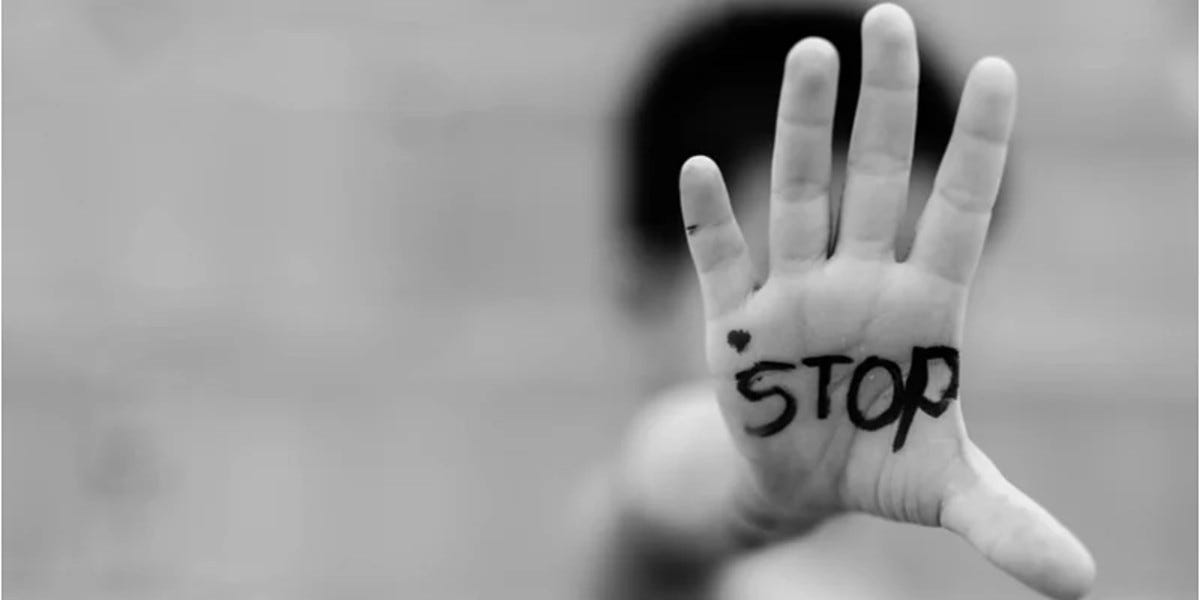
There’s a question that I think every man should ask themselves. Maybe beginning with every woman they know. And then sit down, in a quiet place, and think. Long and hard.
Recently, it was International Women’s Day. And as a woman named Sarah Everard went missing in London, women reflectedon therealitiesof livingin fear ofmale violence. But of course, in a sign of our depressing times, men seemed to miss the point entirely. They created a #NotAllMen hashtag on Twitter, which was completely and utterly losing the plot. The problem is not #NotAllMen, it’s #EverySingleWoman.
I’m going to tell you the question by way of a little story.
I think it was in my late 20s, when one day, I sat down. It was an unremarkable day, just like any other. I think it was in the springtime, which is my favourite season, and I think I was walking through the park, which is what I still do to think. So there I was, just walking, happily, taking in the sunshine and the flowers and the gardens and the crisp clean air of the old park I’ve been walking through for so many years now. Reflecting.
And I stopped dead in my tracks. A certain thought had occurred to me, which never had before. It shut down every muscle in my body. I stopped seeing the sun and the flowers and the sky. The air suddenly tasted cold and deadly. Everything seemed different.
It was a little thought. So little that I can put into one sentence. And yet I never saw the world — or people — the same way again
Every woman I knew, I realized, suddenly, startled, had suffered some form of male violence. Every single one. Not one had been left unmarred by violence at the hands of men. Too much of it was serious, serious violence. And some of it was so casual I didn’t even realize it was violence. There I’d been, blissfully ignorant. Walking through the park. While this world of incredible violence just spun around and around me.
How had I never realised this simple, terrible fact before? It had been there all along, staring me in the face. Just waiting for me to see it. Only I’d been blind. And because I’d been blind, I was deaf and mute, in a way, too.
I considered my history for a moment, carefully. Could it really be true? Every single one? But it was. There were the exes who’d been raped. There were the elders who’d been abused. There were the friends who’d been assaulted. The more I reflected, the longer this litany of violence got. That was what really terrified me.
And shamed me. Because it wasn’t like every woman I knew had been suffered violence at the hands of something I wasn’t. Just men. I was one, too.
I’d known all these stories. I wasn’t supposed to know some of them. The ones about my elders being abused. Some of them were told to me over tearful confessions in bedrooms, like my exes. Some were whispered to me across noisy bars — all those friends who’d been assaulted, warning me that this guy or that guy was an a-hole, a d-bag, someone to be avoided. I’d known all the stories. How hadn’t I connected the dots?
I began to feel physically ill. It seemed to me that I’d pulled on a hidden thread that connected the world together, and everything had begun to unravel. Every single woman I knew had been harassed, assaulted, beaten, or raped. Every single one.
I checked the dim corners of my memory. There had to be one. You know that game people play? The “not all” game? As if, if you can find one exception, just one — then it must prove the whole thing, theory, idea false? It’s a defence mechanism kicking in. Of course finding one counter-example doesn’t prove a general phenomenon wrong. Dogs have four legs, except my puppy Snowy’s friend Lammy, who has three. Still, I searched the dusty cracks of my own history. And I couldn’t find a single example.
I sat down by the edge of the path I’d spent so many days walking. Days and days, which were to become decades. I felt dizzy. Yes, really. I’m not exaggerating for effect. I had no idea that male violence was such a pervasive and terrible force that it affected every single woman I knew in serious and profound and incredibly real ways.
Did that make me foolish? Ignorant? Maybe. I thought of all the books I’d read. The library was my only real escape from the bullies and morons who wanted to kill me every day of my little life. I’d read everything I could get my hands on. I’d read de Beauvoir when I was ten, calling women a “subjugated caste.”
I’d grown up, too, around vocal feminists — even, in those parts, famous ones. Fierce and brave woman, the kinds of warriors who risked their lives every day defending women’s rights in an openly fascist society. They had to live in compounds guarded by men with machine guns — if they were lucky. The ones who weren’t just suffered…male violence.
So if I’d read the books and grown up around women who were serious feminists…how had I still ended up here?You see, I realised that what I’d learned in the books and from my aunties and elders was abstraction. Theory. And that was how I treated it. “Male violence is a social construction of status and power, predicated on…” Etcetera. But I’d never stopped to fully take in the reality of it. The gruesome, the total reality of it. Every single woman.
Was that my fault? Of course it was my fault. But it was also a social failing. I wished that somebody had sat me down at a younger age and told me the grim reality. That male violence wasn’t some kind of abstract theory — but a terrifying reality that was going to affect every single woman I knew, and already did.
What might that have done? I wondered. The only ones who can change male violence are men. Men chafe at the idea that they are violent. They cast their right to harass and abuse and demean and assault as “freedom.” You can see it every day on the internet, where superstar pundits lead mobs against women and call it “freedom of speech” and “criticism.” But of course rape and death threats are not criticism, and they are not really “free speech” either. They are harassment and intimidation. They are violence.
It was a long and strange afternoon. I still don’t have the words, really, to describe what I felt. Grief? Anger? Fury? Disappointment? Shame? Shudders of all those ripped through me. Every single woman. The words just kept repeating themselves in my head over and over again. And nothing made them go away.
So I got up, and kept walking. But something had changed. I could never — ever — see women the same way again. Not even for an instant. I’d never really accepted the patriarchal notion that women were just commodities to exchange, or resources to use, or trophies to win — I wasn’t some kind of macho jock. I was just a punk who wanted to be a poet and a musician. But that hardly meant I wasn’t part of the system of male violence, too. Had I really seen women as people — ever? People who grieved and needed and wanted and desperately feared this terrible system of male violence — from which there was no escape.
Shades of Sartre. De Beauvoir had, of course, been right. Women were a subjugated caste. Subjugated by us men. But now I didn’t just understand it in some dry academic way. But in a visceral and personal one. And that made me see with very, very different eyes.
I thought, too, suddenly, of my best friend. I’d just lost him. It had ripped me up. I only had one best friend. They called it a heart attack, but it was an overdose. He’d been a junkie since he was at that Ivy League college. The one where he never fit in. The one where he was hazed and harassed and assaulted beaten, over and over again. For not being violent enough to be a “real” man. He was treated like a woman, I suddenly thought, with a start, because he wasn’t brutal and cruel and violent enough to be seen as a man. Male violence killed him, too.
I started to cry. I’d loved him like a brother, and I felt lost without him. And then I thought of how male violence had shaped my life, too. All the ways that I’d been hunted and bullied so mercilessly. For what? Because I liked music and art and fashion — not competition and sports and acquisition and status and power? The way the teachers encouraged the other kids to beat the hell out of me, day after day, because it would “toughen me up.” The way that sometimes, the girls would take care of me, because they knew I was on the verge of cracking up totally. I was being treated like a woman, too, because I wasn’t a “real” man. I’d always rejected the system of male violence, even way back then, as a little lost boy — and the price of rejecting male violence as a man is to be treated like a woman. With brutality, cruelty, hatred, vengeance, violence.
Please understand that I’m not saying I’ve been raped or sexually assaulted. I was lucky that way. I’m pretty sure my best friend had. So what am I saying? Let me crystallise all the above as concisely as I can.
Male violence is an ideology and system that still runs and rules the world. To the point that every single woman I know — and every single woman you know — has probably been affected by it. Many of them, probably in deeply traumatic and destructive ways. Rape, harassment, assault, abuse. They are not uncommon things. They are not even common. They are ubiquitous. We men make the world go by forcing it violently into line, and our violence begins with women.
Male violence exerts its price on men, too. If you reject the system of male violence, you are treated like a woman. You are a “bitch” or any other number of misogynistic or homophobic slurs. The abuse begins practically from the day socialisation does, because that’s when other little boys are being taught that being a man is equal to having the right to do violence to non-men. If you reject the system of male violence, instantly, you are not a real man — and therefore, it is fair for any real man to hurt and beat and intimidate you just the same way they do with women, because you have surrendered your masculinity, and that must be punished.
On both of those, men and women, girls and boys, who reject male violence as the solution to more or less every social problem there is, it’s still open season. They are met with male violence to punish them for their rejection of it, so that the system’s integrity is maintained. Go ahead and think about who got bullied at school. Who got the good jobs, and who got the bad ones. Who’s well paid and who’s not. Doesn’t it all tally far, far too well with accepting and even endorsing male violence? Meanwhile, those who reject it, usually, face severe and lasting consequences, from being shunned to being assaulted to being pilloried.
So what does all that mean masculinity is? Masculinity appears to be the right to do violence. Nothing more and nothing less. You can attach a penis to it, if you want. But as far as social construction goes — and I think this holds across cultures — masculinity appears to be the right to do violence. To whom? To everyone who is not a man. Under the protection — meaning ownership — of a man. Which means both women and men who reject the system of male violence. Such people are precisely what de Beauvoir said: a caste that is beneath “real” men. That’s not history, it’s not theory, it’s everyday reality.
If you think I’m kidding, go ahead and think about how the institutions of male violence shape our oh so modern societies. Men grow up in schools where they get away with harassing and assaulting women and not-real-men, who are both seen to be the same thing: people who don’t have the right to violence. They go off to fraternities, where they’re bonded into male violence with male violence. As they grow up, the values of patriarchy are lionized — selfishness, brutality, cruelty, indifference, hostility, aggression, rage — as “desirable,” by employers, universities, clubs, leagues.
Patriarchy is reproduced by every single institution I can think of in our society. No wonder then that male violence still permeates it so absolutely that…
Say the three words with me.
Every single woman.
I said I’d tell you a question I think every man should ask themselves, beginning with every woman they know. It’s a simple one. The one that struck me like a great fist of justice that day.
How many of the women that you know — know well, exes, partners, mothers, aunts, elders — have been affected by male violence? Don’t try to minimise, justify, rationalize. Don’t try to say, male violence is only severe assault. Just answer the question. Ask if you have to. These are stories that should be told, if they are willing to be shared, that is. Tally it up.
The answer, I bet, will shock you. 50%? 60%? You’d be very, very lucky. I’d be surprised if it’s not, just as it was for me, every single woman.
We have this saying these days. “Do the work.” That is the work. I think that’s where the work of being better people begins for a lot of men, as far as gender relations go. So do the work, my friends. I don’t mean this as some kind of anodyne thought exercise. I mean that you should go and really do it.
There’s a reward, too, on the other side.
A few years later, when I was at my sickest, and the light was killing me, only nobody knew that yet — improbably, at exactly the wrong moment, gaunt, ill, feeble, I fell in love. With the woman who figured out what was wrong with me and…saved my life.
The fates took pity on a wretch like me that day, for some reason. And yet I know this much in my bones. I wouldn’t have been capable at all of having that relationship if I hadn’t broken down that spring day and reflected on the true depth of the damage male violence had done. How it had hit every single woman I knew. Taken my best friend’s life, along the way. All that gave me the eyes to see this woman who’d later become my wife as theperson she was. Before she was anything else at all. Exorcising male violence, I think, is the only thing that made it possible for me to have a real relationship at all.
I still don’t know what she sees in me. I’m just glad she does. And I thank my lucky stars, every now and again, when I walk through the old park, that it gave me this strange gift of knowledge. It’s still there. But I’m different. It took me a long time to change. It’s better on the other side. It’s full of grace and goodness and truth and beauty and life. That’s what we attain as we learn to undo the terrible trauma and pain of male violence, which still rips through this world like a heart attack.
Do the work.
Umair
March 2021