
The Age of Imbalance
If It Feels Like Everything’s on a Razors Edge, That’s Because It Is
Does it feel like everything’s on edge these days? From the biggest levels to the smallest? From the world to…your life? I’m here to tell you that feeling’s….right. No, that doesn’t mean “we’re doomed,” but it does mean…what it says. Things are on a razor’s edge. They feel precariously balanced, like everything could tip over anytime. And all that’s true in deep way.
What do you see when you look at the world? Here’s what I see. Tiny, tiny changes could go a long, long way. And yet civilizationally, we seem to be incapable of making even those. Economically, financially, systemically. And so things are balanced on this razor’s edge — and it feels like we’re running out of time.
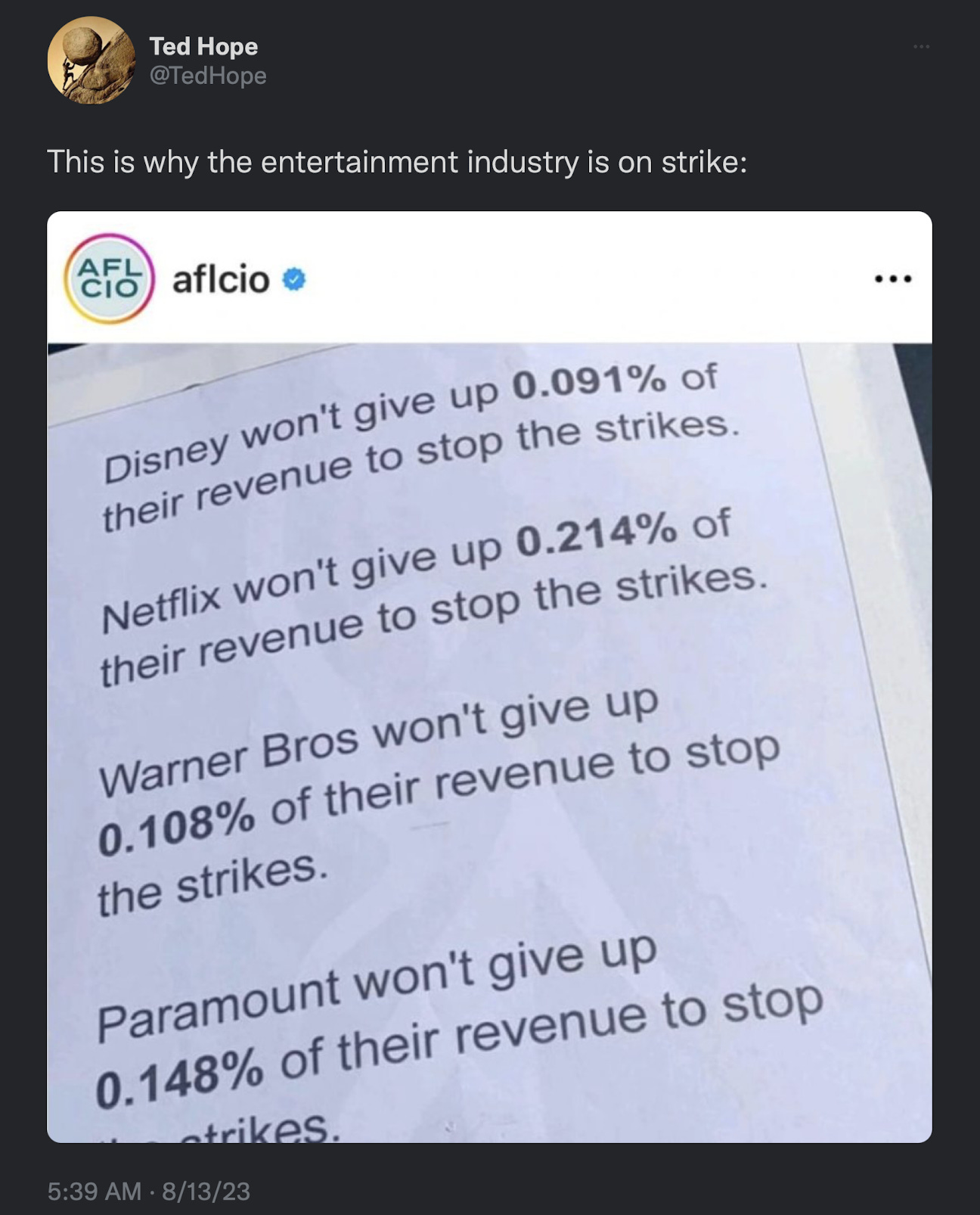
That’s abstract, so let me make it concrete. We’ll start with a small — but telling — example. Take a look at the statistics above. Hollywood’s on strike, as you might know. What would it take to stop it — what are writers and creatives asking for? As it turns out, miniscule proportions of the incomes of the giants they work for. The numbers are startling when you put them in perspective. 0.091% of Disney’s revenue. 0.2% of Netflix’s. 0.108% of Warner Brothers’. 0.15% of Paramount’s.
Are you beginning to see what I mean? The writers and creatives in Hollywood aren’t asking for a lot. They’re asking for a relative pittance. Less than 1% of what their industry makes, in hard terms. And yet even that change can’t be marshaled. So Hollywood’s on the razor’s edge. That the rest of the world is, and I don’t just mean in terms of labour and strikes.
When you look around the world, you’ll begin to see this theme emerge…everywhere. Casually, we call it, often, paralysis. Setting in. Systemically, institutionally. But a better way to describe that is: we seem to have become incapable of making even tiny changes — the very ones we need to — if we want our systems to go on functioning. Hollywood’s one example, and I raised it because it’s easy to grasp and relate to. But now let’s zoom way, way out.
Let’s think about a much, much bigger topic — climate change. There are China and India, building new coal plants. Meanwhile? “Rich polluting countries are three years overdue on their promise to mobilise $100 billion a year in climate finance for low- and middle-income countries.” $100 billion might sound like a lot, but America’s GDP is $20 trillion…alone. $100 billion is… 0.005% of America’s GDP. That’s relative pennies.
So as a world, we can’t mobilize pennies to stop climate change. Think about that for a second. Hence, here we are, on the edge — watching the mega-scale impacts of climate change ravage the world, this First Extinction Summer, from Rhodes to Hawaii to Canada and beyond.
See the theme again? Tiny, tiny amounts. Fractional ones. What we economists call “marginal amounts,” meaning, the ones at the edge that make the difference. We can’t raise, mobilize, change, even in marginal ways, it seems.
But even that’s the relatively small picture when it comes to climate change. You’ve seen the apocalyptic pictures and video from Maui. The death toll’s still rising. Is this America’s first climate…mass death?
Let’s think about the much bigger picture, which is the totality of climate change. Right now, what we spend to stop climate change is on the order of $600 billion. It should be — and this isn’t my estimate, it’s a generally recognized one — around $4.3 trillion. That’s a big jump in relative terms. But in absolute ones? Let’s think about it the same way we did Hollywood — in percentage terms. What is the planet, a livable one, our future on it, really asking for, in those terms? Our GDP as a world is around $100 trillion or so. So we’re looking at 4% of GDP.
Not “spending” it. Investing it. In what? In…everything we hold dear. In towns not suddenly being leveled by mega fires like in Maui — or by floods, like in Norway, as just one example. We need to invest 4% of our GDP as a globe to…have a future. Instead of facing worse and worse ravages every summer. Just now, places in America are hitting the wet bulb limits of human survivability. The costs of mega-scale climate change are surely going to outpace 4% of GDP, when you add them up, from crop failures, to runs on banking and insurance systems, to broken food and water systems, to unemployment, to falling health and longevity. One estimate puts those costs at 20–30% of GDP.
4% of GDP. That’s not a lot. Again, it’s a marginal amount. We spend far more on…nearly everything else, from militaries to healthcare. And this is the investment in history with the greatest returns — remember, we invest 4% to save a loss of 20–30%, and probably enjoy renewed prosperity and stability for an age to come.
If you want to know where that 4% goes, it’s in everything from renewable electricity, of course, to the things we don’t know how to do yet at scale, from green agriculture to building materials to household goods to hardening infrastructure, to creating the industries and research of tomorrow, on which these all depend.
See the theme again? We’re talking marginal amounts. On one level, it’s true, we need a series of revolutions, and the greatest wave of investment in history — sure. That’s in relative terms. In absolute terms, the changes we need to make aren’t on the order, of say, suddenly having to invest 50% of GDP to fight off an alien invasion. These are small changes — though they’re not incremental ones. History will look at us, baffled, and say: they couldn’t invest 4% of what they made…in not seeing their civilization go up in smoke?
Let me take that even further. The razor’s edge. Where are we, in terms of climate change? Many scientists worry that we’re on the edge of hitting tipping points. It feels that way, too, looking around the globe, at the way mega-scale impacts suddenly seemed to arrive this summer, from great heat domes stretching around the globe, to continent wide megafires we don’t know how to put out. Think of those fires in Canada — they take us close to a classic tipping point. The forests burns, they release carbon, and store less. Canada’s emissions from the fires already exceed everything else for the year — and they’re not done burning yet. So you see how it all links up: unable to mobilize marginal amounts, efforts, resources, changes, we come closer and closer to the edge. In this case, of tipping points that we really don’t want to hit.
Let’s take another example still — one that might infuriate you. Covid. How many times has Covid been declared “over”? And yet here we are — another season, another wave, another variant. How did we get here? Well, even taking basic precautions became taboo. Wearing masks, sanitizing your hands, air filtering — almost no national health agency even bothers recommending these anymore, despite the WHO’s entreaties. Most barely even keep track of statistics anymore — and so now rises the phenomenon of “unexplained mortality,” as if we don’t all know the cause.
Again, see the theme — marginal changes. What are we asking people to do when we say wear masks? How did it become a norm not to wear them? Even marginal changes were said to be too much. The world was to go on as before. And so now you’ll hear any litany of reasons why taking basic precautions can’t be done. And so it’s become this weird, bizarre, thing — taboo to protect yourself or society from a pandemic, whose consequences only grow more concerning the more we find out about them, from brain damage to heart damage. Despite those levels of very, very real harm — which you can see in all this “unexplained mortality” — marginal changes were…too much.
The theme’s universal, by now. Marginal changes would go a long, long way — from Covid to climate change. But we’re not making them. We don’t make them. We don’t take them seriously, socially, politically, economically, culturally, and I don’t mean you, I mean the big “we,” the collective one. Weirdly, perversely, in fact, those small changes become the very taboos we’re not supposed to talk about, mention, enact — like wearing masks, or discussing how little we actually invest in a future, a planet, democracy, prosperity.
And so of course things end up on a razor’s edge. Will there be another wave? How much worse will next summer’s fires, floods, and mega-weather be? Why are our economies so stagnant? How come our politics are so stuck? The answer remains the same. We’re a paralyzed civilization. It’s exactly those marginal changes which matter most right now — the ones at the edge, which make the difference, from investing just that bit more in climate change, to taking basic precautions against Covid, to people making a livable income. All these things are fractional. In absolute terms, they don’t require…much at all.
And that’s what history will find baffling about our age. Not that it demanded levels of change that no civilization could make — but that it required fractional ones, and yet, we resisted even those, while everything was on the line, went to the wall, and a great unravelling began.
Umair
August 2023