
The Age of Climate Despair
The Understanding’s Slowly Dawning That Our Civilization’s in a Climate Emergency
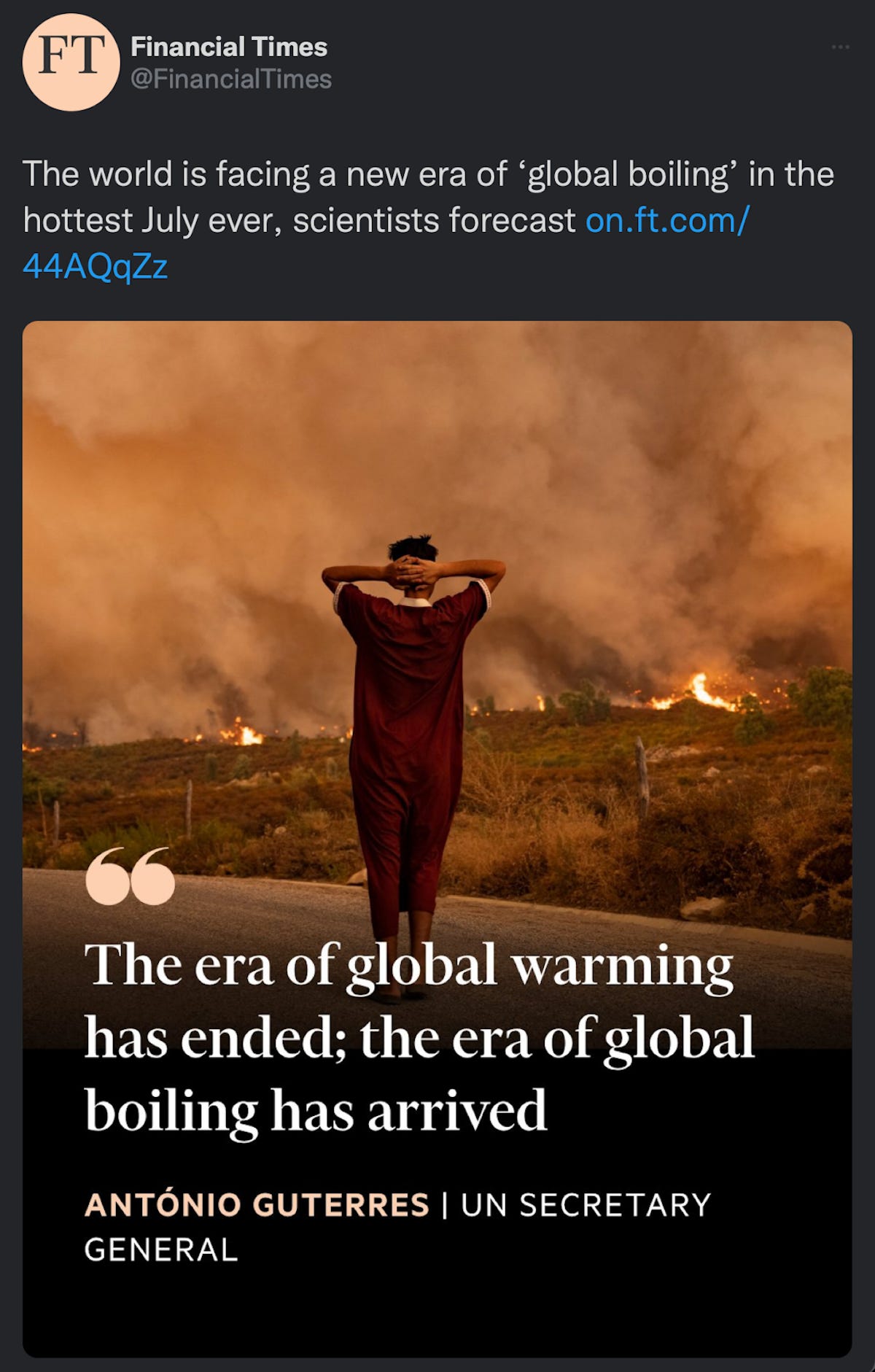
Everyone, meet 2023’s latest villain: the doomer. What you might call doomer-shaming now fills the pages of august newspapers, from the Guardian to the Washington Post. Bad Doomer! They cry. Don’t you know it’s not…that bad!
I think this deserves a certain scrutiny. Because our systems have a certain tendency: they tend to downplay risks, in the name of “balance,” while promoting a kind of feel-good optimism. It’s happened time and time again over the last few years, yielding more and more disastrous results. The pandemic, which they tell us is “over.” The rise of fascism, which was presented as a heroic story of intellectuals and brave rebels taking on The System. Is this what’s happening with….climate change?
The doomer-shaming argument — call it the optimists’ argument, if you like — goes like this. It advances three central claims. “We have the technology to solve climate change, we just aren’t applying it fast enough.” So: one, we have the ‘technology’, two, ‘we’ aren’t ‘applying it’, and three, hidden in all this, a claim of ‘not fast enough’, meaning we just need to scale up our current efforts.
But is any of this true? Does this argument carry any water?
Let’s examine the claims one by one.
‘We have the technology to stop climate change.’ Do we? What doom-shamers mean when they say this is the following: they use it as shorthand for certain regions in rich countries having shifted to renewable energy. So wind and solar and so forth are growing. That’s a good thing, but does it equate to ‘we have the tech to stop climate change’?
Our civilization doesn’t know how to make any of its basics without fossil fuels. None of them. Not food. Not cement. Not steel, not glass, not industrial chemicals, not plastics. There are substitutes beginning to arrive for some — a tiny few — of these huge, globe-spanning industries. Like bioplastics, or green steel. But they are at the scale of a town or a city. They are nowhere near capable of supplying a civilization. Not even remotely close.
Think of the simple example of food. Modern industrial agriculture depends on fossil fuels to produce fertilizer. What exactly do doom-shamers mean, then, when they say ‘we have the tech to stop climate change’? We emphatically don’t have a replacement for industrial agriculture — green agriculture is a field which certain nations are trying to pioneer, like the Netherlands, but to imagine that it’s going to be able to feed a civilization very soon…when it can’t even feed itself on such a supply yet…is unrealistic in the extreme.
So: ‘we have the tech to stop climate change’? Do we? Let’s delve even deeper into the logic. This means: regions in rich nations have switched to renewable energy. And so America’s carbon emissions have stabilized, albeit at very high levels, while Europe’s have fallen. But this is a false economy. Looking at it from just the perspective of emissions, sure — looks like great news. But to the economist in me, things are less rosy.
What are America and Europe? The world’s largest consumers. What do they consume? Imports. From where? Poor nations, like China, India, Bangladesh, etcetera. What’s involved in manufacturing all those things the rich West voraciously consumes, from electronics to household goods, in the poor East and South? That’s right, emissions.
If we were to look more honestly at the emissions of the rich West, we’d use a lens called something like “consumption weighted emissions.” That means: if I consume, buy, say, a meal and a broom and a gadget today, just because that stuff isn’t made within my borders, doesn’t mean we can get away with saying “we didn’t emit.” It would look at the total emissions down the production stream of a given good, and assign them to the consumer, at least in part.
That’s because it makes little to no sense to say that it’s “just” the poor East and South that’s “emitting” carbon, when it’s doing so to satisfy the rich West’s demand. To put that another way, if a rich Westerner buys a good made in China, it’s not the Chinese worker who’s going to use it — he’s just made it for the rich West, who enjoys a cheaper price, because of course, there’s no carbon price attached to it. So this is a game of emissions-shifting, really. If we looked at the world this way, we’d see that in fact, America and Europe still emit significant amounts of carbon, on a consumption-weighted basis.
I raise all that because it’s crucial to understand how the world actually works. The world isn’t just a video game — there’s some ‘tech’, drop it on a fictional city. In the real world, we have institutions, systems, politics, and economics at play. ‘We have the tech to solve climate change’ meaning rich countries have managed to slow or stabilize their emissions here and there — it doesn’t apply to the world nearly yet, precisely because even as rich countries do that, which is good, they’re still basically responsibly for emitting vast amounts of carbon that are assigned to poor ones, because their demand is what quite literally creates those emissions.
Keep reading with a 7-day free trial
Subscribe to HAVENS to keep reading this post and get 7 days of free access to the full post archives.