
Is Climate Change Our Equivalent of a World War?
Why Climate Change Is Different — And Why We Can’t Solve It Using the Paradigms That Procured It
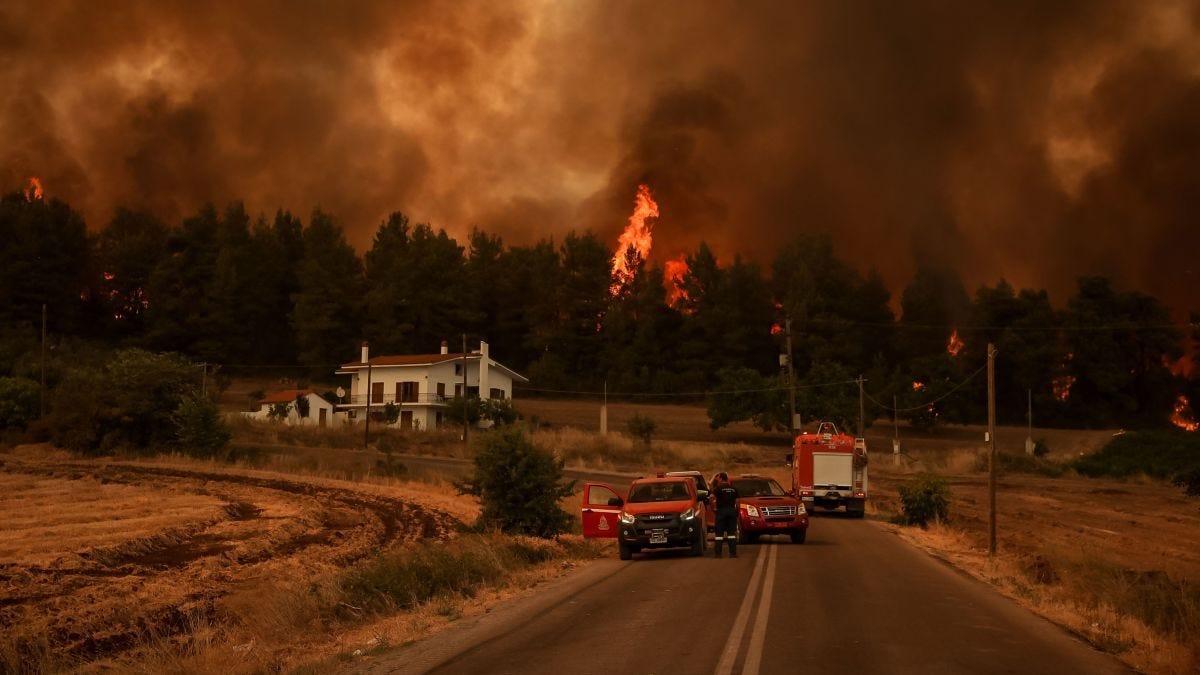
It’s been an apocalyptic summer. Our first Extinction Summer. Look around and tell me things are going well. Sicily. Greece. Canada. On fire. Oceans, boiling. Those orange skies over Manhattan were just weeks ago. Global heatwaves. Every summer after this gets worse. Emissions still rise.
We’re grasping for a way, at last, to understand climate change, now that its belatedly entering the public awareness. Is it a crisis? An emergency — as one leading scholar’s asked Biden to declare?
One of the lenses that’s emerging is that of a war. It’ll keep emerging, because as summers like this one become normal, and get worse, nations will have to utilize military responses to climate change. Consider the following. It’s about Canada’s coast-to-coast megafires — more than a thousand are burning.
But fire control is also growing harder because the fires themselves are changing. They produce such thick walls of smoke now that tanker planes sometimes can’t fly into them; they throw embers over what were once considered uncrossable fire breaks; they burn and smolder underground through winter; they get so hot that firefighters risk second-degree burns just approaching them. “The most powerful firefighting equipment that humans have — Canadair planes that cost roughly $35 million each and drop 30 bathtubs’ worth of water at a time — can extinguish fires with an intensity of up to 10,000 kilowatts per meter of fire line,” Henry Mance wrote recently in The Financial Times. “Today’s megafires are a different order of magnitude, sometimes exceeding 100,000 kilowatts per meter” — 10 times as intense.
How bad is that, in reality?
The megafires routinely produce whole new fire-weather systems, including what are called pyrocumulonimbus clouds, laced with lightning and whipped by tornadoes, which can shoot toxic aerosols all the way through the troposphere into the lower stratosphere. It was long believed that only volcanic eruptions were capable of doing this. It wasn’t until 1998 that scientists discovered pyrocumulonimbus clouds from megafires doing it, too. So far this year in Canada, there have been 90 of them.
“They can’t stop these fires,” says the fire historian Steve Pyne. “I mean, they could have 50,000 firefighters there now, and it’s not going to change it. We could have 200 more air tankers. Are they going to be able to stop these fires that are going? No.”
Lesson: we don’t have systems and institutions capable of responding to climate change’s catastrophic effects. Firefighting is a clear and good example. Our firefighting systems were meant to deal with house fires, or yesterday’s everyday forest fires. But mega-fires from coast to coast? Producing their own pyro-weather systems? Burning ten times as fierce? We just don’t know how to put out fires like that.
You could also take any example you like, really. Mega-monsoons and floods. The breakdown of water systems. Crop failures. Civil unrest that’ll spread as a result. Militaries will eventually be called in to deal with these problems, because they’re the last line of defense we have, really. Right up to building seawalls, climate change will transform into a matter of national security, whether we like it or not, because, of course, it is.
So: is climate change our equivalent of a World War? In a sense, it’s reasonable for militaries to be called into climate duty, if you like. Better than…many of the misadventures, the misguided wars, that politicians dream up. It’s not too hard to imagine a day — not too far off — where militaries are involved in everything from fighting fires to distributing water to building walls against rising seas to providing disaster relief after floods and tornados have struck to handing out respirators as air becomes unbreathable.
There’s a problem with thinking about climate change that way, though. It’s not just that militarization is of course anathema to democratic societies, though it is. It’s deeper.
Imagine an enemy which never tires. Never falters. Which, no matter what you throw at them, just keeps on coming. Their resources are inexhaustible. Their morale unshakable. Their army is bigger than yours, and it replenished itself every single day.
That’s a more realistic understanding of climate change.
Keep reading with a 7-day free trial
Subscribe to HAVENS to keep reading this post and get 7 days of free access to the full post archives.