
Is Britain Finally Ready To Admit Brexit Was a (Catastrophic) Mistake?
Britain’s Self Inflicted Catastrophe Is Turning Out….Exactly Like We All Warned It Would
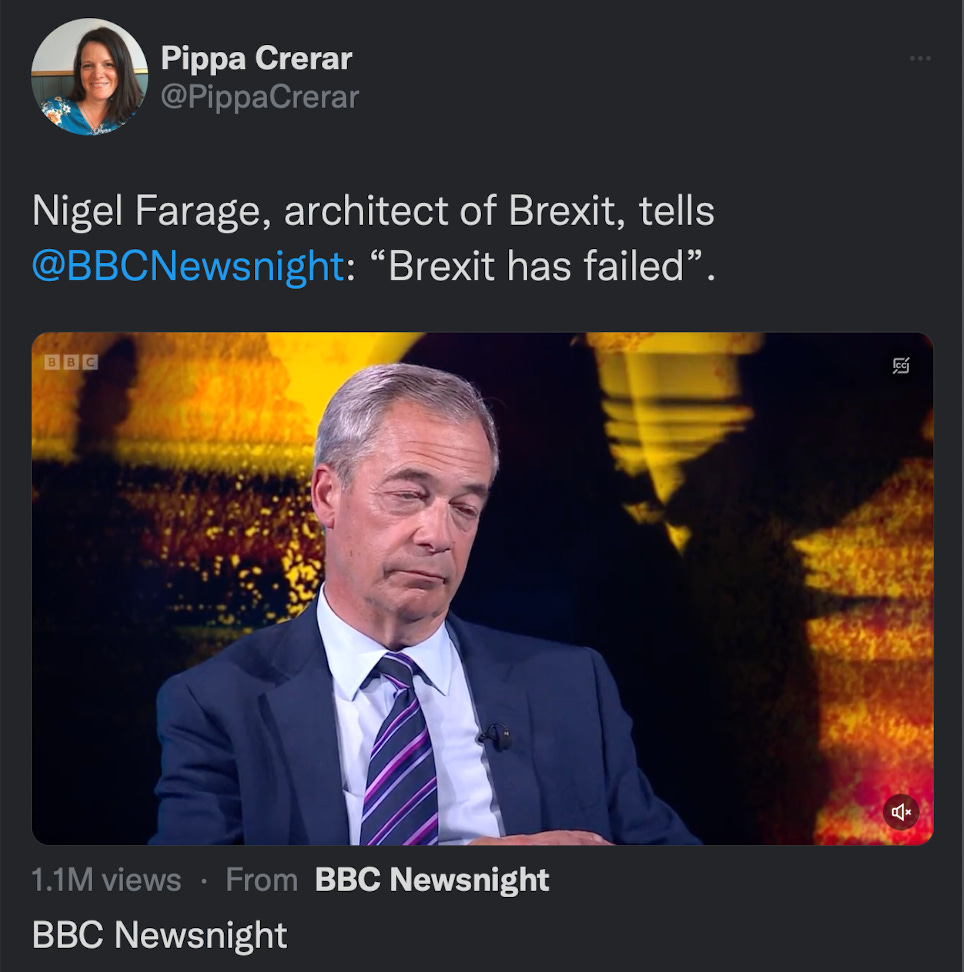
Something cosmically, tragically funny happened today. Do you know who Nigel Farage is? He plays a character, also called “Nigel Farage.” That character is a sober gentleman of the British Establishment. The kind who wears finely tailored suits and pocket squares. And “Nigel Farage” — the character, the man, take your pick — was almost single-handedly responsible for what turned out to be one of the greatest calamities in modern history: Brexit.
Today, Nigel got up on a stage, and said: “Brexit has failed.” Shrug. Hey, who would’ve thunk? Maybe you see the painful irony. You could almost hear the rusty gears of thought clunking into motion. This comes after years of lampooning Europeans, immigrants, refugees — everyone, really — as not British enough, in order to basically set up the Big Lies of Brexit, the slogans that would incinerate a nation’s rational mentation. We’re going to “take back control!” “Britain First!” “Brexit means Brexit! (Whatever that one even means.) To basically make poor, bewildered Brits, barraged by this arsenal of mendacity, believe that fantastic illogic that…giving up the right to live and work in Europe…was going to make their lives…somehow…better
When Britain’s top Brexiter admits that Brexit’s a failure…LOL. What now?
Let me give you an analogy. A metaphor. You go to a doctor. A quack. He gives you pills. You take them for a while. Instead of feeling better, you feel worse, much worse. The quack doctor says: so sorry, my treatment failed. Meanwhile, it turns out, those pills gave you cancer. This is where Britain is now.
There are a hardy, foolish few who still think Brexit was a Great Idea. But they’re dwindling by the day. Because, well, Britain’s in tatters. Britain’s still not ready to give an ounce of credit to figures who were critics of Brexit — nope, no media coverage for us. Still on the blacklist. But the average person’s cluing into the sheer destruction of Brexit because, well, the state of Britain is disastrous, and I don’t say that lightly.
Do you know what happens if you call the doctor in Britain — a real one, not Doctor Nigel? You’ll get a message, odds are, saying “no appointments are available.” LOL. Now what? You…just…keep calling. And maybe, if you’re really, really lucky…you’ll get one. In a month. Three. Six.
Brexit destroyed Britain’s real crown jewels: the NHS, the BBC, and membership in the EU. And each of those acts of wanton, mind-boggling self-ruin are going to have a price. That price is going to take generations to pay. This is the part that nobody in Britain wants to discuss, because, well, we critics are still on that pesky — whoops, better not say it — blacklist, persona non grata, perhaps as unwelcome as the “boat people” its government is currently blaming for all of the country’s problems.
Brexit took a few years. But its consequences are going to last generations. Britain is now on a path, set firmly in stone. Decline is far too kind a word. Wreckage is probably more appropriate, and let me explain to you why, in detail, so that I’m not accused of being a “Scaremonger,” even though Nigel’s eating his words, and all of those coming from critics of nationalist manias like Brexit, like mine, have proven to be all too painfully true.
Let’s think of the NHS for a second — and use it as an example of all of Britain’s public services, from trains to waterways. They’re all in shocking states of disrepair. What happens now? Britain’s economy is now smaller. It’s going to keep shrinking until a new post-Brexit equilbrium is reached. That’s going to take a decade, and on current estimates, the economy’s going to be maybe 20–30% smaller than it would’ve been without Brexit. Or get this:
The Government’s economic watchdog, the Office for Budget Responsibility, has said that the post-Brexit trading deal reached with the EU will reduce Britain’s long-run productivity by some four per cent, compared with if the UK had remained in the bloc.
It added that both exports and imports will be around 15 per cent lower in the long run than if Britain had stayed in the EU.
Britain’s economy is flatlining and shows no signs of any significant pick-up.
What do smaller economies not get to have? Nice things! Like functioning public services. Like cutting edge healthcare systems, next-generation infrastructure, high speed rail — Britain’s sole project for that is now delayed until, LOL, 2045 or so, because there’s no money. Not a coincidence. A relationship. Proof. An example of exactly the relationship at work here, that all us hated “scaremongers” warned about: a smaller economy was going to hurt people.
By costing them a functioning social contract. Now that Britain’s going to get poorer, for at least a decade or so, until at last the contraction stops, and it’s a withered shell of what it could have been — what sort of social contract’s left? Not much of one, is the answer to that question. A post-Brexit Britain can’t really afford a proper NHS, at least not the way it used to be. High speed rail? Nope. Next-generation infrastructure of the sort, that, for example, Biden’s investing colossal sums in? Not that, either, because, well, that’s what a shrunken economy means. It’s for this reason that we critics used to warn: Brexit is austerity by any other name.
Keep reading with a 7-day free trial
Subscribe to HAVENS to keep reading this post and get 7 days of free access to the full post archives.