
How’s Our Civilization (Actually) Doing? You Probably Don’t Want to Know
Are We “Doomed”? Wrong Question. Why Is Everything Falling Apart, Faster and Faster?
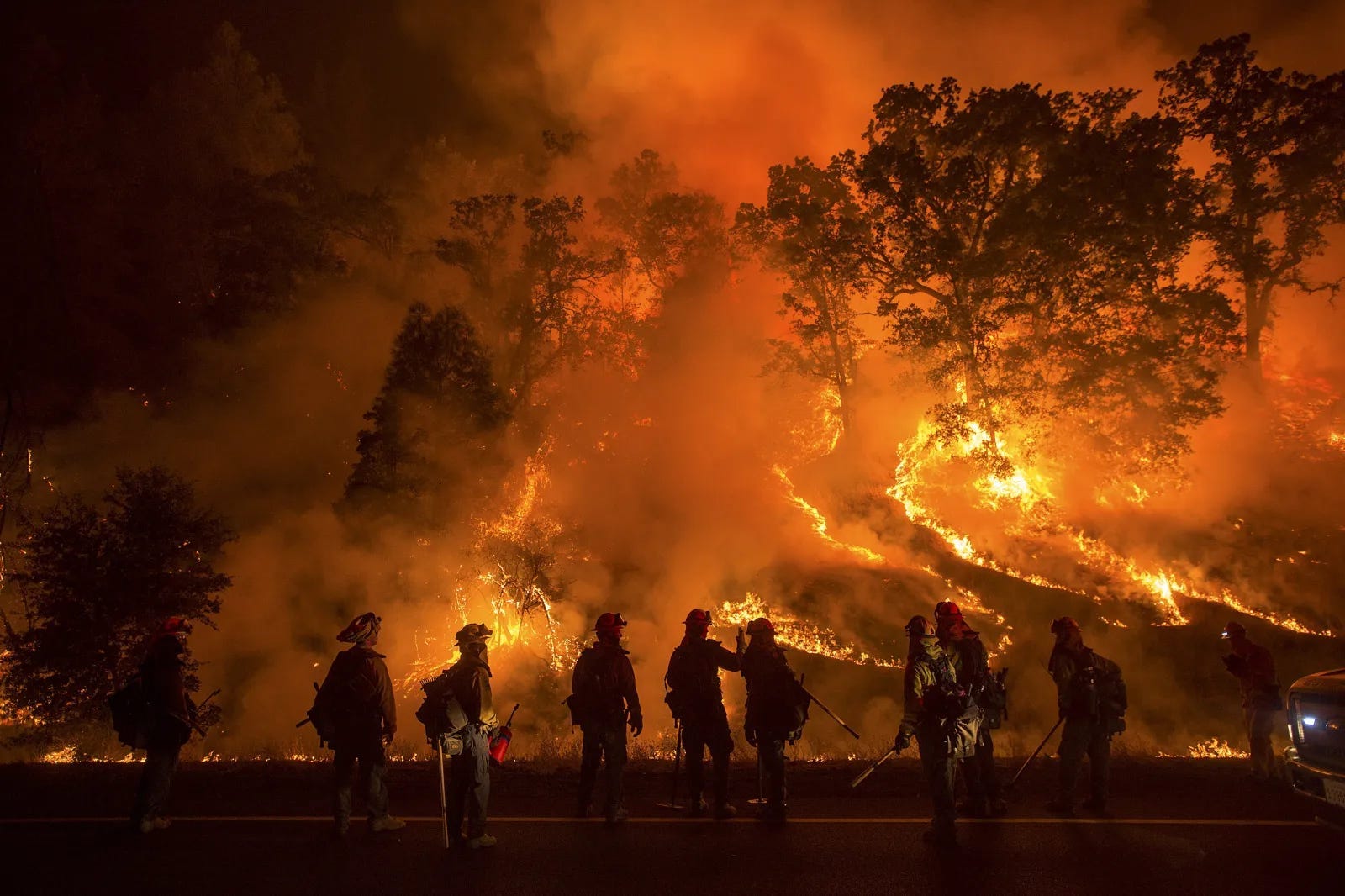
If you read newspaper columns — like I do — you might have noticed there’s a new sort floating around. It goes like this. The “Doomers” Are Wrong!! Look at Those Foolish Doomers!! We’re not Doomed — So Why Do These Damned Doomers Keep on Saying We Are. It’s funny, because this is how discourse works. An idea begins to circulate and reproduce.
I suppose that people like you and me are — to columnists like this — card carrying “doomers.” I’ll come back to that, because, well, I think that at this point “doomer” has become a kind of thing that power excels at: basically an insult, as a substitute for substance. Doom? It means a lot of things, and none of them, mostly, are the caricature painted by the “The Doomers are Wrong!!” crowd. But I get ahead of myself. What strikes me about these columns is their…lack of substance.
Let’s do a little civilizational report card. It’s easy enough, to call people funny names, and laugh them off. But it’s harder to really do the difficult work of thinking well about serious issues. When we actually look at the state of our civilization — in factual, empirical terms — the results are…well, you’ll be able to judge for yourself in just a moment. The Report Card.
— Life. After centuries ascending upward, progress has flatlined and ground to a halt. That’d be progress in the biggest terms, what economists and social scientists call “development indicators.” They include everything from life expectancyto trust to happiness and many more. They represent our truest picture of life itself, how people’s lives are doing.
— Economics. Living standards are declining in 90% of countries. Real incomes are plummeting across the globe. That’s because inflation’s skyrocketed, while wages have been stagnant for decades in many countries. Meanwhile, amidst this wreckage, the merely super rich have grown ultra rich. They now have more money than anyone could spend in a hundred lifetimes — and yet the average person is going into debt because they can’t make ends meet.
— Society. Each generation now does worse than the one before it, and that’s become an entrenched, long-run trend. We have four to five generations with sharply declining outcomes and fortunes. Gen X began the trend, Millennials did worse than they did, and now Zoomers are doing worse still. Count the generations on the edge, and that’s five generations of decline.
— Politics. Democracy’s in steep decline around the globe, enough for political scientists to speak of “democratic backsliding” as a defining feature of this age. That’s an altogether too polite way of saying that a wave of fanaticism — whether fascism, authoritarianism, theocracy, nationalism, or weird admixtures of all the above, like America’s “Christian Nationalism” — is surging around the world. India, China, Russia — right down to Sweden and Italy. No corner of the globe is left untouched.
— Ecology. But the points above may in truth be small fry, compared to this one. We are running out of our most basic, critical, fundamental resources. The ones which provide our necessities. We are now running short of water. Food, hence skyrocketing prices. Clean air, which is what Covid, and the pandemics to follow it, really means. Energy, as the last few years have so brutally shown. What happens as we run out of these things at a civilizational scale — crops fail, water sources dry up, energy grids sputter out?
— Psychology. It’s hardly surprising that all of this has left people feeling seriously and profoundly threatened. People are more pessimistic now than at any point during the last century. Anxiety, rage, anger, and despair are the defining sentiments of now — along with maybe the numbness of endlessly scrolling some algorithmically generated infotainment feed.
I could go on. But it’s hardly necessary. All the above are facts. They aren’t opinions, speculations, or even conclusions. They’re empirical truths about our civilization. What grade would you give us? You can be the judge of that, but no reasonable person could hardly give us a very good one.
We are in a new age, and while that phrase often means good things, this time, it’s so dystopian that scholars have had to invent a new word for all the above: “polycrisis.” Each of the points above is its own crisis, and each one of them would be bad enough for any age, challenging, threatening, arduous enough. But all of them, together, at once? That’s something new. Genuinely unprecedented, even in humanity’s long history of war and conflict and strife.
Polycrisis only begins to point to the scale of what we’re facing. And “scale” is precisely the element that needs to be grasped well here. The points above don’t just apply to one nation here or there. They affect and afflict us at a civilizational scale. They are worldwide problems. It’s not just the Colorado River that’s running dry. Rivers are across the globe. It’s not just that real incomes are falling in ever-troubled America. They are more or less across the world. Polycrisis doesn’t just mean “we have a lot of little crises in various countries.” It means “we are beset by a baffling set of civilization scale crises, each of which is lethal enough in its own right, but when they intersect, well, their risk only multiplies.”
Keep reading with a 7-day free trial
Subscribe to HAVENS to keep reading this post and get 7 days of free access to the full post archives.