
How Much More Is Brexit Going to Wreck Britain’s Future?
Britain Wanted to Leave the Modern World — And It’s Finding Out the Hard Way What That Really Means
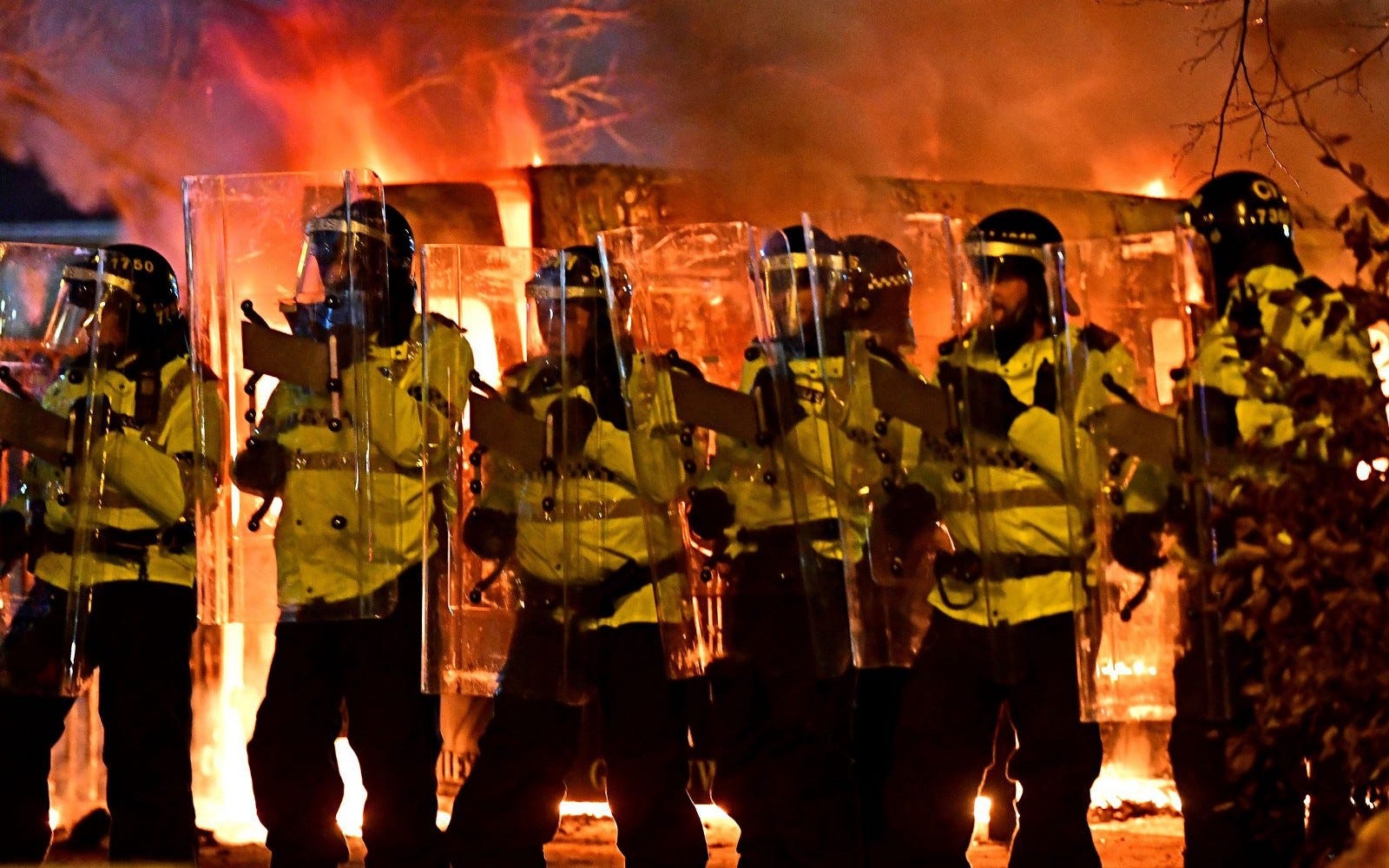
See that? That’s a portrait of modern Britain. The far right set a police van outside a hotel on fire. Just because… penniless refugees lived there. The kinds of people the government demonizes as “invaders” and blames for the country’s problems, like the NHS collapsing. This is where Britain is. So where does it go from here?
Umair, what is your projection for 5 years on in this post Brexit Britain?
This question is understandably on a lot of minds, so thank you to the person who sent it to me. First, of all, do you want the answer that’s acceptable in Britain? AKA the diplomatic one, a half truth? Or the actual one? If it’s just the former… this article may not be for you. For those who understand that’s probably yet another Big Lie, let’s move on the actual answer.
First, let’s set some terms. Terms of credibility. How do I know what’s going to happen? Well, in this case, it’s almost deterministic. Clockwork. There’s very little that could happen to cause Britain to deviate from the path I’m about to lay out. Some decisions are that catastrophic. That it’s, as we say in social science, “path dependent.” That is, when you make some choices, they cause your entire trajectory to deviate, in a predictable, and predetermined way. The other set of paths — in between the two which have now bifurcated, split off from one another, at the point of criticality — those are no longer available to you. They’re gone.
This is where Britain is now.
What did Brexit really do? How has it worked out? By now, we have something we didn’t before — and we should never have needed. Evidence. In cases like this, you don’t need the evidence. In some circumstances, economics allows us to issue predictions with near-certainty. We know what’s going to happen. Imagine you go to the doctor, and she says, listen, if you don’t have treatment, you’re not going to make it. You chuckle. Scaremongering! Experts! Who needs them!! And then a few months later…you’re in serious trouble. It’s a shame that it’s come to this. This meaning what, precisely, though?
Well, Brexit has already exceeded most of the most pessimistic predictions. Let me say that again, because this point isn’t being made in Britain, because the taboo that you can’t speak ill of Brexit still holds, more or less, and certainly that you can’t speak any truth or reason or sanity about it. The most pessimistic predictions have already been shattered. Good economists — plenty of us — we estimated that the British economy would shrink by about 10%, compared to what it would’ve been, had it stayed in the EU, in the “medium term.” To us, that means “within a decade.” That much has already happened.
You want to know what happens next. I get it. You’re impatient. But to do that, you have to understand where Britain is now. It is in a much, much worse position than nearly anyone in it really understands. A much worse one. Certainly than anyone in power fully grasps. Your economy’s in double-digit-smaller-than-it-should’ve-been territory…in just two to three years after you made such a choice? What happens in, say, ten? Let me put that in another way: if the evidence is in now, and it says that Brexit has done so much damage in just two or three years, damage that was expected to happen over the medium term…what happens over the actual medium term?
There are three possibilities, most people think. One, the bleeding stops soon. Maybe here. Maybe this is as bad is it’s going to get. You make a bad choice, you take a knock, OK, it happens. We can take this, handle this, OK, 10%, no big deal. People make this assumption of going-back-to-normality because that is the way many things happen in life. But not all things. Some mistakes are big ones. They change the course of a life or a nation…for good. Divorce, for example. So is that…really true? Remember what I said about determination and path dependence. Sometimes…the bleeding doesn’t stop. What if you hit not a mere vein, but an artery?
That brings us to possibility two. Things get better again, suddenly, magically. Let’s call this one the “sunlit uplands,” as everyone’s best friend Boris Johnson famously put the shining opportunities of…breaking up with your best friends in the world. LOL, let’s go straight to number three, because that’ll explain why this one has about as much chance of coming true as, say, Andrew Tate becoming the next pope. This isn’t just wishful thinking, it’s empirically flat out impossible.
Which leaves us with possibility three. The bleeding doesn’t stop. The economy just keeps on contracting. Into…oblivion. In a way that we haven’t seen since, say, the Weimar Republic. In a way that doesn’t happen in the modern world, except when far poorer countries — Asian ones, Latin American ones — have full blown currency crises (I’ll come back to that bit of jargon, for now, just think of nations like Argentina or Venezuela imploding periodically.)
Three possibilities. The bleeding stops. Magically, the patient on the table undergoes a faith healing, and his youth is restored — Brexit actually begins to work. Or the bleeding doesn’t stop, because, well, you hit an artery. Which of these is correct?
What was Brexit really for? I know that’s a numinous question, so let’s leave aside the deeper sense of it — a notion of moral superiority, the feeling of a lost empire, and so forth. Brexit was for a simple enough reason: Britain was going to restore its waning economic fortunes by doing “trade deals” with the world, which couldn’t be done when it was part of the EU. Meanwhile, leaving the EU would “free” Britain to follow a different economic model from European social democracy, and its high standards for everything from labour to food to rights — a more American one, in which “entrepreneurialism” and “dynamicism” would be “unleashed.”
Keep reading with a 7-day free trial
Subscribe to HAVENS to keep reading this post and get 7 days of free access to the full post archives.