
How Bipartisanship Made America a Failed State
You Can Have “Bipartisanship,” or Transformation — But Not Both
Why is America a failed state? There’s a strange principle responsible for the breakdown of American politics over the last few decades, which has reached crisis point now.
“Bipartisanship,” as it’s called in America. Let me give you an example. Joe Biden now has to get his ambitious infrastructure proposal passed. And the Republicans — the nice ones, not the outright fascists — have offered an olive branch. They won’t accept $2 trillion, but they’ve offered $800 billion.
(The fact, though, is that $800 billion — over a decade, which is $80 billion a year — isn’t enough to even make a dent in America’s problems. It’s a tiny amount, and as I’ve discussed, even $2 trillion falls well short of the $6 trillion necessary for genuine social transformation, which we can estimate based on Canadian and European social contracts. But I digress — anyways, that’s “bipartisanship.” The other side offers an “olive branch,” and you take it, because, well, bipartisanship is something good and kind and noble to aspire to. Or is it?)
I put it in quotes because Americans don’t understand how odd a principle “bipartisanship” really is, since it’s become a kind of political ideal and aspiration — or at least the charade of one. It doesn’t exist in any other rich country, because almost none of them have two-party political systems — and in the scant few that do, the idea that you should compromise with the other side, instead of oppose them, is laughable, because it’s hopelessly naive.
Because they’ve grown up in a society where “bipartisanship” is a social norm, a cultural ideal, Americans accept it.
The problem though is that like all great social myths, “bipartisanship” only really exists to hide an ugly truth. One which is easily revealed by thinking for just a moment about what it really means.
When a pundit, columnist, lobbyist, or even Senator invokes “bipartisanship,” what do they really mean?Something like this: that the Democrats should accept whatever offer the GOP makes them, if they’re lucky enough to even get one. While the GOP shouldn’t really offer the Democrats much at all. “Bipartisanship” like so many sociopolitical terms, is a kind of flimsily disguised code word. It doesn’t really mean “both parties,” it means “one party gives, and the other takes.”
Bipartisanship, in other words, is asymmetrical. It only goes one way. When the GOP’s in power, they’re not interested in the slightest about it — they ram through whatever they like, and they’ve done it from the time of Reagan and before. When the Democrats are in power, though, they’re to take seriously and consider carefully what the Republicans want, because, well, bipartisanship.
Of course, this myth of bipartisanship — that the reality of it is asymmetrical, leaning heavily to one side, which is the far right — is a recipe for producing a failed state. Because what it’s meant in practice is this.
Beginning in the 80s, from the time of the Reagan Revolution, which was a backlash to the civil rights gains of the 70s, Republicans did whatever they wanted, in more and more extreme ways. They slashed social investment to the bone, to the point that by now, Europe and Canada invest triple what America does on basic public goods, like healthcare, education, retirement, childcare, and so on, which, of course, is why Americans live without those things. At the same time, they “deregulated” the economy, so that profit-seeking corporations — huge monopolies — could earn towering fortunes by fleecing Americans for basics, whether insulin, water, or money itself.
“Bipartisanship” legitimised all that. It was the GOP’s duty, job, role, to take — and not worry itself much, if at all, about what the Democrats wanted. So they didn’t — and the GOP grew more and more extreme over the years to the point that just a few months ago, its fanatics attempted a violent coup. (Remember that?)
Meanwhile, the Dems, having accepted the myth of “bipartisanship” did just what you might expect. When they weren’t in power, they were ignored, laughed at, and abused — and when they were, they were to be nice and considerate and cautious. They were to think carefully about what the GOP wanted, even though the GOP didn’t give a hoot what the Dems wanted. Which is why the Dems never proposed, really, anything remotely on the scale of a New Deal or Marshall Plan, to this day. The myth of bipartisanship was too busy teaching them that their role was to accept the abuse, to take the pain, that only tiny, incremental change was possible.
“Bipartisanship” is, in other words, a massive, gaping double standard. One the size of the Golden Gate Bridge. It’s a double standard so epic that it’s one of the key mechanisms of America becoming a failed state. Still don’t believe me?
Imagine, for a second, an America without the painful, foolish myth of bipartisanship. How would it be different? Well, the GOP’s behaviour wouldn’t have changed. They would have gone on doing their worst anyways, being fanatics and bullies and aspiring tyrants. What would have changed is that the Dems might not have believed that they should sit back and accept all that, in the name of some mythical political goodwill that never existed to begin with.
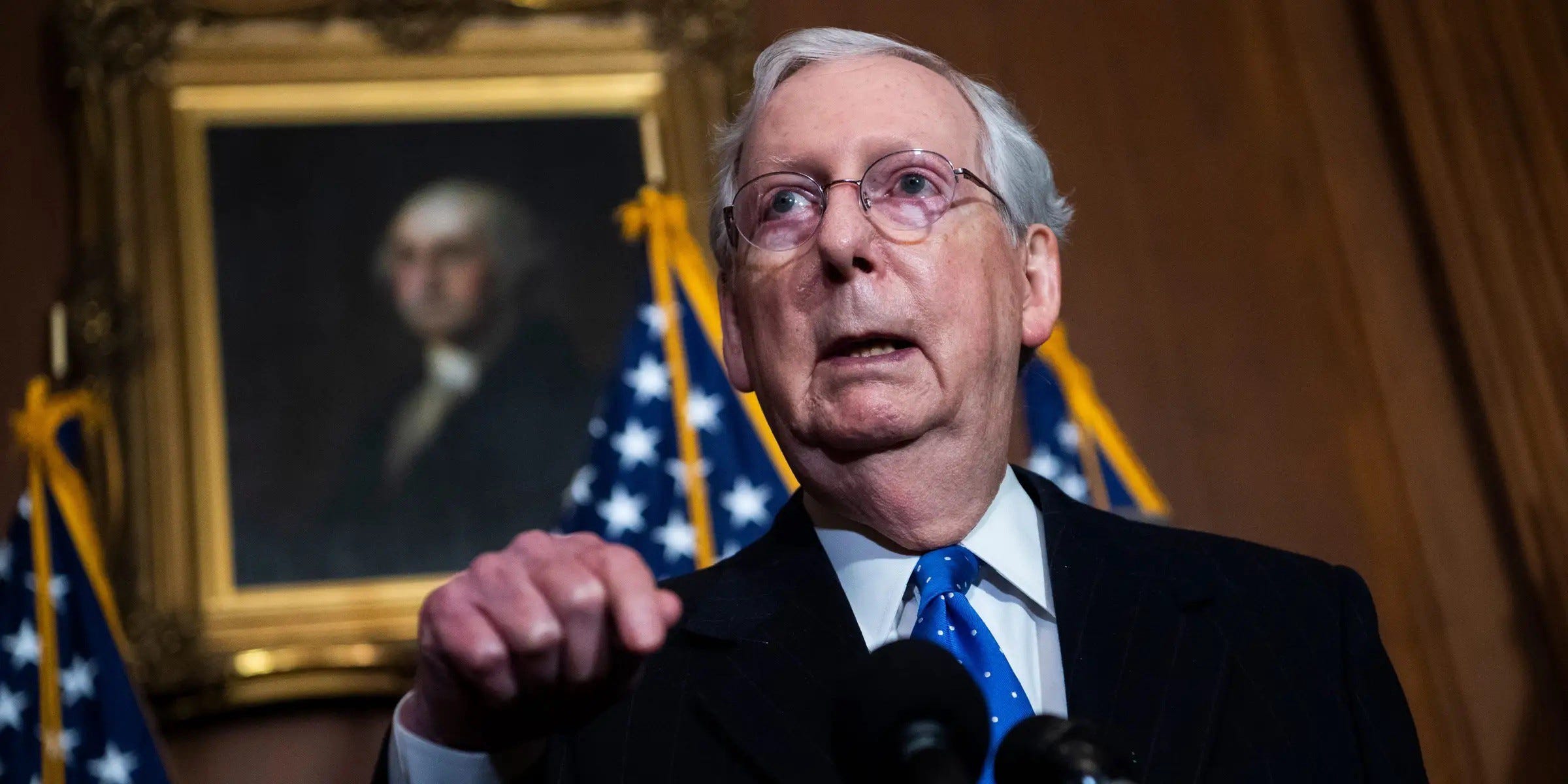
After all, if the goodwill bipartisanship was premised on was there at all — would the GOP really treat the Dems like this? Like dirt? Remember, the fanatics who attempted the coup wanted to kill everyone they could, from Nancy Pelosi on down. And even after all that, the Republicans refused to convict the President who incited and led the coup. And then — adding insult to death threat to injury — Mitch McConnell stood on a podium and apologised sheepishly for it.
But apologies aren’t good enough. This isn’t a date — it’s politics. If the GOP bore the Dems any goodwill at all — even the tiniest shred — surely they wouldn’t be exonerating a violent, fanatical coup attempt.
Maybe you see what I mean by “they myth of bipartisanship is one of the key ways America became a failed state” — or maybe you always saw it. The point, if you understand all the above, is pretty simple — and yet the Dems don’t quite get it.
You can have bipartisanship, or you can have real socioeconomic transformation in America — but you can’t have both. The reason is that “bipartisanship” is a double standard, an asymmetrical norm, in which the GOP takes, and the Dems give.
The results are already predictable. The Dems haven’t studied their economics well or carefully enough, and so they’ve come in with a low, low proposal of $2 trillion over $10 years, which falls far short of the $6 trillion America needs to have a social contract on par with Europe or Canada. To become a truly modern society, America needs to invest way more than the Dems are already proposing — triple that much.
The Dems, meanwhile, have come in with such unambitious proposals precisely because they’re already obeying the rules of bipartisanship. Don’t want to offend the Republicans! Hey, we’d better not propose something politically “impossible”! They might get angry again!
Only right now nothing is politically impossible. The Democrats have all the power you can have in the American political system. They are not using because of the myth of “bipartisanship” — they have drunk the kool-aid of their own powerlessness, which means they come in with inadequate proposals, and then wait for the GOP to even object furiously to those.
Now, you might object at this point. “Hey! The Dems are doing the best they can! They’re proposing truly massive numbers!!” No, they’re not. You only think they are because you believe in the myth of bipartisanship, too.
What has the GOP proposed as it’s number to invest in America? Zero. Forever. In fact, worse than that — less than zero, which is why America’s become a decrepit, ruined, failed state.
Next to zero — or less than zero — anything looks ambitious.
And that’s the point of the myth of “bipartisanship.” Nobody calls out the GOP and says: “Hey, you guys say we should invest less than zero forever, and that’s how we ended up this ruined country. So, by the way, $2 trillion isn’t some huge number — it’s a third of what Canada and Europe invest, relatively, which means it’s still not nearly big enough.”
That’s how a good negotiator would play the game. The Dems don’t, because they’re not good negotiators, because the myth of bipartisanship has taught them they can never use their power. They must always accede, submit, relent — what the GOP wants, even if it’s not in power, matters more than what the Dems, even if they are.
That’s not going to cut it. Not this time. This is it. America’s last chance to become a modern society. Before the dominoes of climate change and ecological collapse start falling, and the hydra of fascism grows another head. After this short window — mere months, really — for transforming America the failed state, it’s game over.
Let us hope, then, that the Dems begin to get it: you can have bipartisanship — the myth, the double standard of it — or you can have socio-economic transformation. But you can’t have both.
Umair
April 2021