
Does Our Civilization Have a Future?
A Look at How We’re Doing, And Some (Dismal) Conclusions
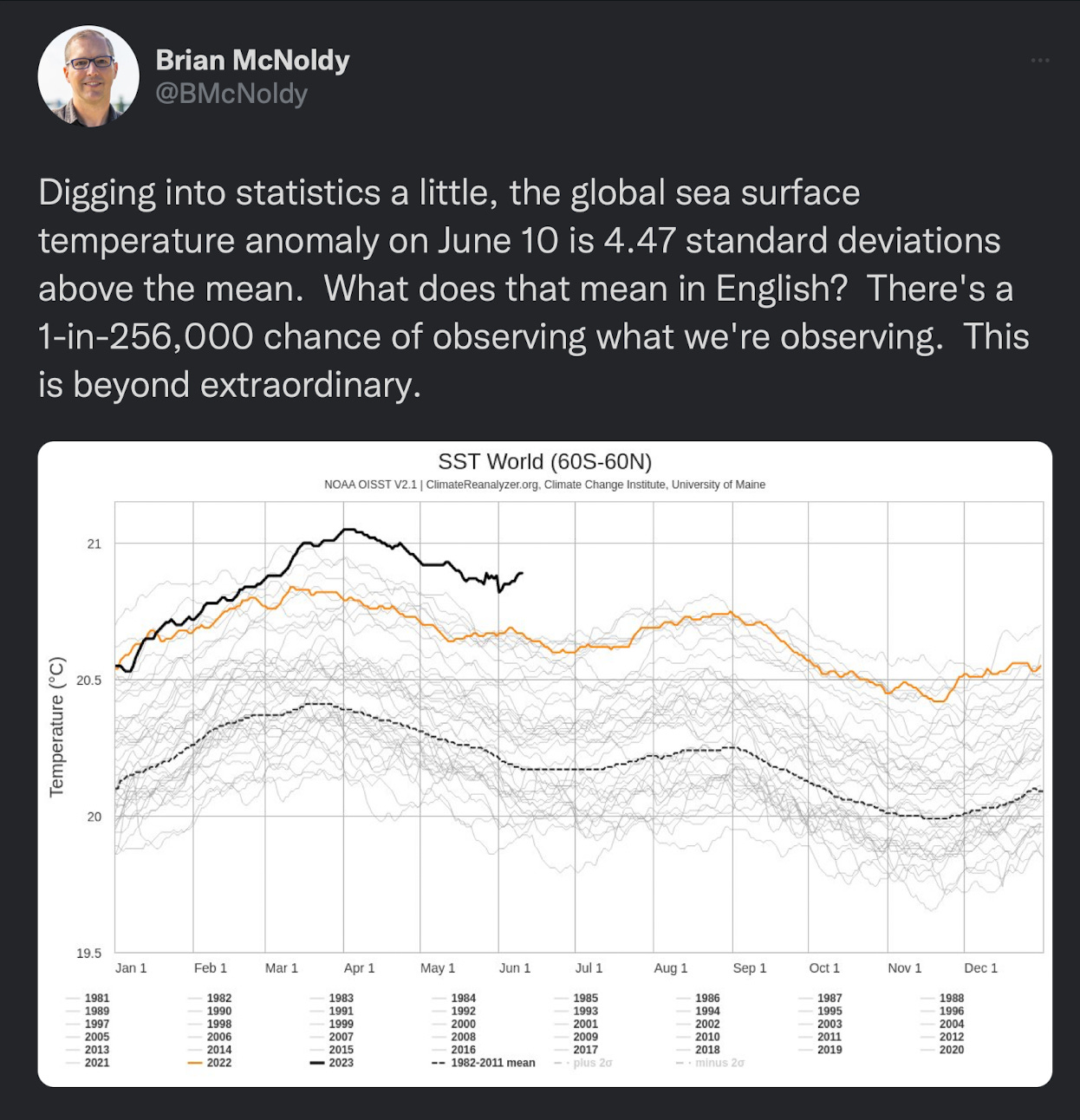
Right about now, scientists of all kinds, planetary, earth, meteorologists, have begun using a new vocabulary to describe…the state of the planet. Shocking, bewildering, extraordinary. They’re in dismay. To that chorus of voices, add an economist — me.
For the last few days — weeks, really — I’ve been building an integrated picture of where our civilization stands. Really stands. A kind of objective portrait of it, if you like. It’s necessary because right about now, we have tons of data, flooding us, of all kinds — about economies, ecologies, the climate, biodiversity, politics and democracy, society — and it’s hard to…keep track of. Like me, probably, you “doomscroll” — and I’ve come to understand that’s an inelegant way to say, at least for thoughtful people, “trying to keep track of this tsunami of startling data, coming at you from every angle these days.”
Now. Over the coming days and months, I think I’m going to develop all this into an index, and we’ll talk about that. It’s something I should have done for many years, but foolishly, I was caught up in more mundane pursuits. Family, making music, walking the dog. But now I think the time has come. Before, I’ve written about the point of such a thing — a number, I call it Epsilon, that we can use to say “this is how well, or badly, our civilization’s really doing.” I think we could all use that number — governments, businesses, academics, everyday people, families. So…I’ll take some time to construct it. But for now, here’s the beginnings of such a thing.
This is the most critical juncture in human history — all 300,000 years of it. The choices we make now will shape everything — the planet, life on it, what kind of civilization we can have — for a very, very long time to come. So how do things look?
Let’s start with the economic picture. I’m going to give it to you straight. Remember when people would say I’m being an alarmist? Here, take it from the World Bank, who’s now caught up with me. These are some of the best economists in the world.
The overlapping crises of the past few years have ended a span of nearly three decades of sustained economic growth that brought the world a massive reduction in extreme poverty. Starting in 1990, productivity surged, incomes rose, and inflation fell. Within a generation, about one out of four developing economies leaped to high-income status
The result could be a lost decade in the making — not just for some countries or regions as has occurred in the past — but for the whole world. Without a big and broad policy push to rejuvenate it…
Basically, we’re in for a prolonged period of stagnation. For a decade. Maybe more. Maybe…permanently.
Why?
This broad-based slowdown in the growth rate of potential GDP has profound implications for the world’s ability to tackle the growing array of challenges unique to our times.
Translation, as the economy hits a wall, we’re less capable of solving our big problems. In what precise way?
Keep reading with a 7-day free trial
Subscribe to HAVENS to keep reading this post and get 7 days of free access to the full post archives.