
Britain’s NHS Is Dying — And It’s a Warning to the World
The Tragic and Shocking Collapse of One of the World’s Great Post-War Institutions
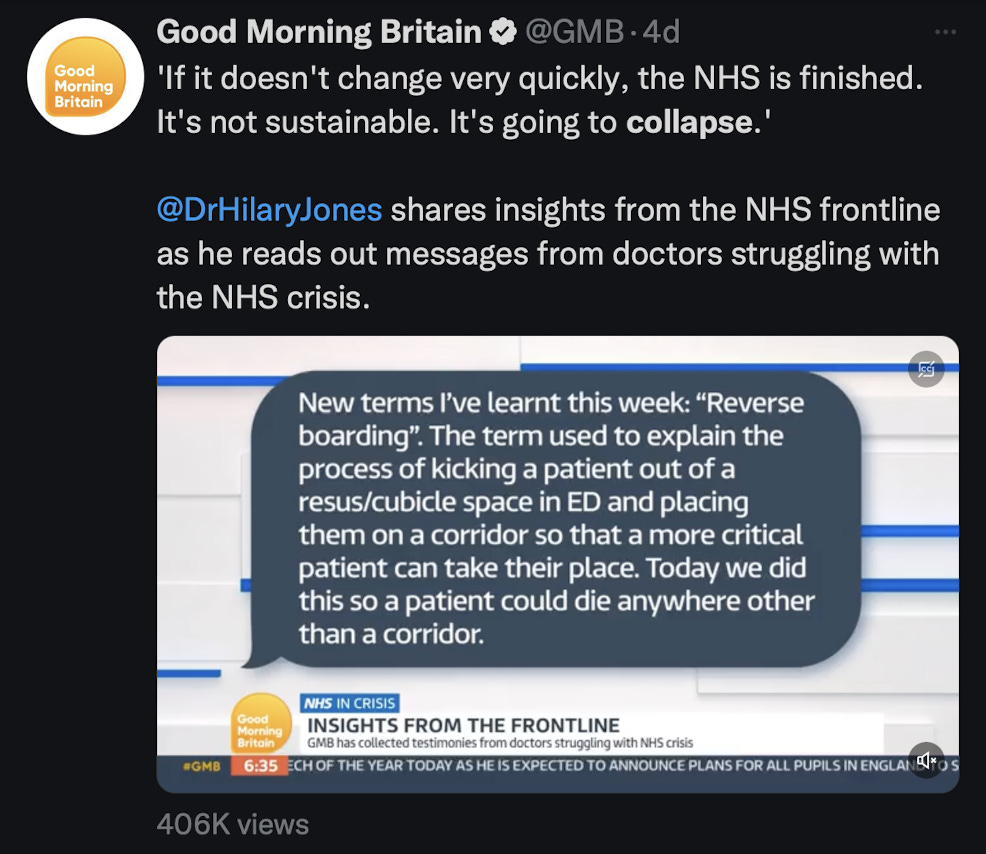
You don’t have to look very hard to see it. Britain’s NHS is collapsing. Now, oddly, the very first thing a certain kind of Brit will do is…get angry…at me…for pointing it out. But it’s hardly just me saying it: Germany’s Die Welt is just one of many publications to have articles with headlines like “Great Britain: a health system facing collapse.”
The death of the NHS is a turning point for Britain — and for the world. Because the NHS, while you might not often think of it that way, was one of the modern world’s great institutions, a model, a pillar, and a pioneer. Think of the world we once took for granted. In the ashes of the last World War, a new set of social contracts, offering expansive rights and systems that people had never enjoyed before, in all of human histry, were born. And foremost among those was the NHS — one of the world’s great post-war quantum leaps of civilization itself.
So to see it die? We should all shudder. But are we? I get the sense that even Brits don’t really fully grasp what they’re losing, don’t seem to care enough, are numb by now. I’ll come back to the Big Picture, though. For now? Some, let’s shade in the littler one.
How bad is it? When I say the NHS is “dying,” is that just hyperbole, or what Brits like to call “scaremongering”? Let’s consider just a few simple facts.
According to OECD figures, France has 5.7 beds per 1,000 people, compared to the UK’s 2.4 and an OECD average of five… Patients with heart conditions are seen by a specialist within 28 days in Paris, with 70 the longest wait recorded elsewhere. In England, there are more than 340,000 people waiting for cardiology care, with about a third of those waiting longer than the maximum target time of four months. In France, the time between a cancer diagnosis and the start of treatment averages less than six weeks, while patients with potentially life-threatening conditions are typically seen by a consultant within six days of referral, half within two days. In England, 18,600 people given an urgent referral for suspected cancer last year waited at least 100 days to start treatment.
Those are shocking numbers. They point to a healthcare system in a state of collapse. Collapse here means something very, very simple. People can’t get basic healthcare anymore. Just getting an appointment to see a GP has become something of a running joke.
And then come the real horror stories. People waiting more than 99 hours for a hospital bed, ambulances that don’t arrive, people taking their loved ones to the hospital on their own strapped to planks, the couple that’s kindly offered to take people to the hospital in their…car…because there are no ambulances, everyone from nurses to paramedics striking because their incomes have fallen while they’re overworked while they have to watch people die.
And yes, people are dying. It was just last week that the head of the Royal College of Emergency Medicine estimated that up to 500 people a week are dying because they can’t get emergency care. 500 people a week? Adjusted for population, for a country Britain’s size, that’s a 9/11…every single week. We are talking that level of catastrophe.
And that’s just the emergency medicine part. Who knows how many more are dying because they can’t beds, basic medicine, treatment on time? Go ahead and guess. Double it. Now we’re up to a thousand people a week, or a 9/11 every few days.
That is what a collapsing healthcare system means. It should make you shudder. And yet Brits aren’t shuddering, at least not nearly enough. They don’t understand what they’re losing.
What are they losing, exactly? Well, I’d say that “the idea” is to replace the NHS with American style “health insurance,” but that’s not just an idea anymore, it’s actually happening.
NHS trusts with record waiting lists are promoting “quick and easy” private healthcare services at their own hospitals, offering patients the chance to jump year-long queues, the Observer can reveal. The premium treatments are being offered through private patient units owned and operated by NHS trusts and typically located on hospital premises. Procedures are often carried out by the same staff who would eventually treat patients if they stayed on the NHS waiting list.
LOL — did you get that? Literally the same resources — doctors, operating rooms, hospitals, right down to electricity and anaesthetic — are being used. Only now you can jump the queue…if you pay. I have no problem with private healthcare — none, I think it’s great, in fact — but when it replaces public healthcare, as in erases it, in a literal economic way, then, yes, there is a problem. Because they are not substitutes for one another — they should only be, in economic terms, complements. Private healthcare, sure, by all means. But everyone should have healthcare.
And having to wait a year for basic procedures — or not being able to get an ambulance — is not having healthcare. It’s the promise of having healthcare, maybe, but it’s not the reality of it. In that sense, the NHS has already collapsed. It’s not some future state we’re talking about. It cannot deliver care to people right now, on any basic level anymore, really, hence, we’re already seeing skyrocketing excess deaths.
Keep reading with a 7-day free trial
Subscribe to HAVENS to keep reading this post and get 7 days of free access to the full post archives.