
Brexit’s Three Years Old. How’s It Going? Catastrophic Is an Understatement
The Question Isn’t Just How Bad Brexit Is. It’s How Bad It’s Going to Get.
It’s the third anniversary of Brexit, and by now, it’s becoming clear just what a calamity it’s really been. Britain’s in a state of chaos, well on its way to being a failed state — and the heart of its collapse lies Brexit. Guy Hands, one of Britain’s top financiers, minced no words, calling Brexit a “complete disaster” and a “bunch of total lies.” So…how bad is it?
Wrong question. The question facing Britain now — and the one the world can learn from — is: how bad is Brexit going to continue to be?
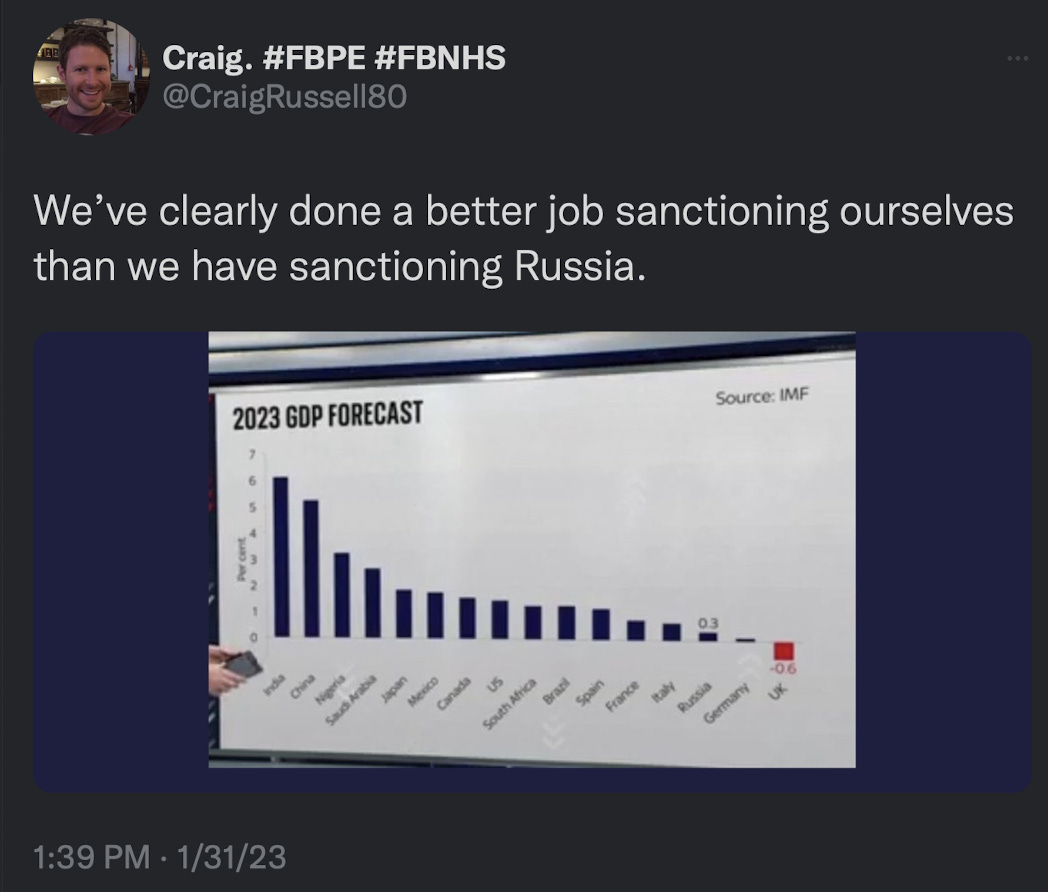
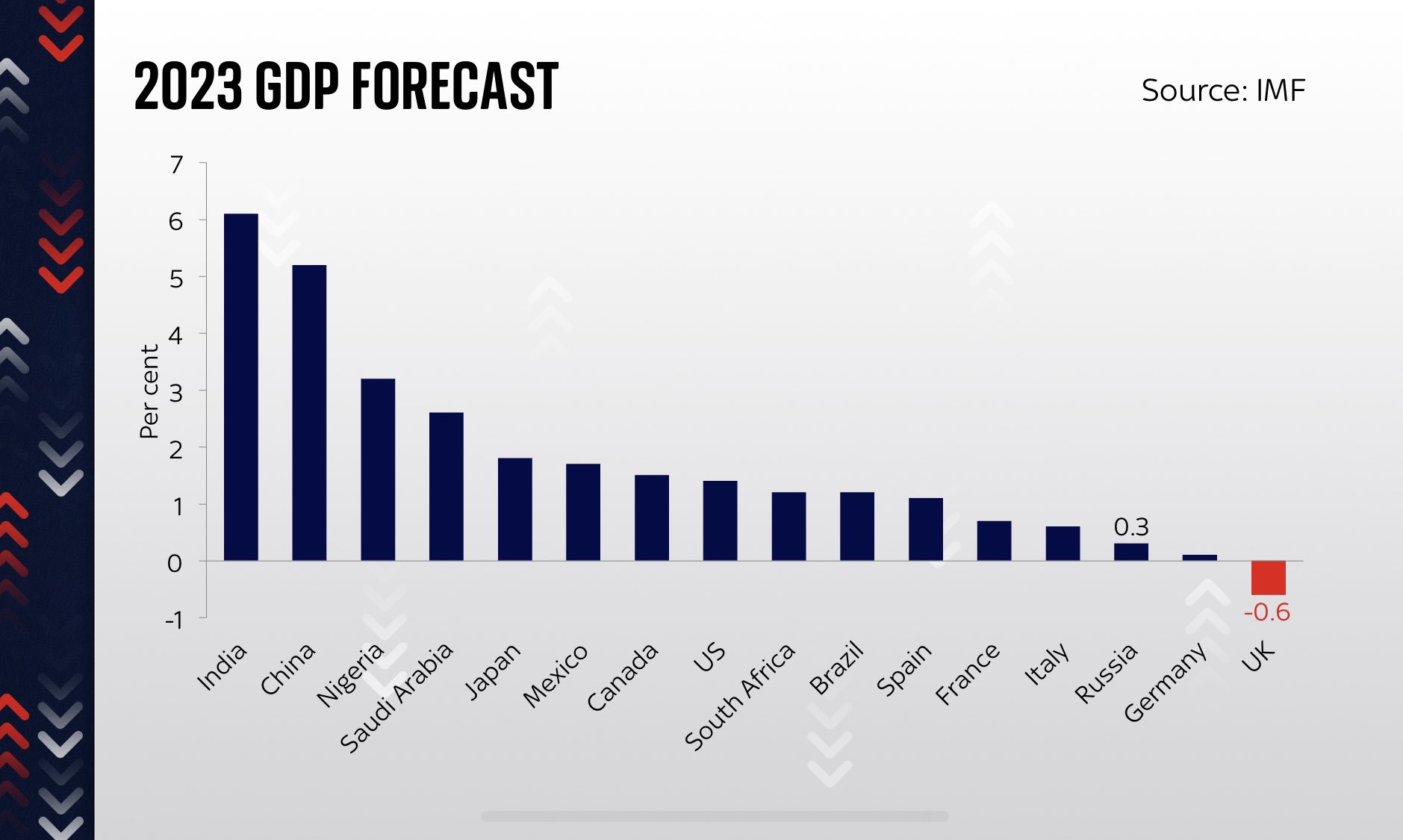
Let me explain. Take a hard look at the chart above. It made the rounds, because it shows something frankly astonishing. Britain’s going to be the only economy that shrinks this year — while even Russia’s economy is going to grow. “We’ve done a better job sanctioning ourselves,” one critic pithily put it, “than we have sanctioning Russia.” Exactly.
And yet all this is…just the beginning. Let’s go back a step, so you understand how cataclysmic Brexit really is, and then what the future holds. The most authoritative estimate is that Brexit’s already led to Britain’s economy being 11% smallerthan it would’ve been had it stayed in the EU.
Now let’s couple those two facts. A) Britain’s economy isn’t growing, and isn’t going to for the foreseeable future. B) Britain’s economy — just three years into Brexit — is already 11% smaller than it would’ve been had it stayed in the EU. Project that into the future. What do you get?
An incredibly grim picture, which looks something like this. The rest of the developed world is reverting, slowly, to more or less normal post-war growth rates. Somewhere between 3–5%, probably, maybe a little less, as climate change begins to bite. And then there’s Britain. Not growing at all. Add that up over a decade, and what do you get? You get an economy that’s 30% smaller than its peers.
That is…unparalleled. For an economy to see a double digit loss of output — the 11% since Brexit — is already unprecedented. But for a rich, developed nation to end up 30% poorer than its peers? That’s genuinely unparalleled. It makes economists like me reach for superlatives that we can’t find, and then get accused of exaggeration, and yet the fact is that nothing remotely of the sort has ever happened in modern history. We have never seen a rich, developed economy just stagnate while its peers grow, to the tune of losing 30% of its future output. That is a Big Deal.
It means that Britain is poised to become a much, much poorer country.
Now, these aren’t just abstract economic figures. They point to an incredibly grim reality which is already unfolding on the ground. Try this headline from one of Britain’s top broadcasters: “Britain cold, hungry and miserable, new figures show.” How bad is it?
Almost a quarter of adults have not been able to ‘keep comfortably warm’ in the two weeks before they were surveyed, according to the Office of National Statistics (ONS). As many fear running out of money to buy food, around one in 5 adults reported eating smaller portions.
It’s been a brutal winter everywhere. And yet statistics like these show us that what the larger economic numbers point to is already happening. Britain is plunging into poverty. It is becoming a poorer country, at light speed. When 25% of people say they struggle to keep warm, and almost that many worry about running out of money to buy food, something has gone very, very wrong with an economy.
Those are numbers that are the living face of another grim statistic Britain’s living standards are cratering. Brits are facing the fastest, sharpest fall in post-war history. Though in Britain it’s become de rigeuer to speak about the present moment as if it were shades of the 70s or 80s, the fact is that this fall in living standards is — I’m going to have to use that word again — unprecedented.
Now. Why is the scenario above unfolding? Why is Britain’s economy stagnant, while others — even Russia, LOL — are beginning to grow again? The reason for that is very simple: Brexit. Britain broke up with it’s largest trading partner, and the Brexiteers told the Big Lie that trade deals with the world would soon follow. They haven’t. Even America’s giving Britain — notably — the cold shoulder, because, well, Britain’s government keeps on doing distasteful things that America’s wants no part of. The reason that these trade deals haven’t materialized is straightforward: Britain’s a net importer, of more or less everything. So when it goes to strike trade deals, the baffled reply from the other side of the table is: “but what do you have to sell us?”
I bring that up for a reason. Britain is now in between a rock and a hard place, or what an old poet might have called Scylla and Charybdis. It isn’t going to be able to strike the trade deals the Brexiteers promised — they haven’t happened, which is a pretty good signal they aren’t going to, for the obvious reason above. That means the British economy keeps on shrinking for the foreseeable future.
That is how you get to the scenario I’ve outlined above: an economy that’s withered away, and is now 30% smaller than its peers.
This is the future Britain faces. It’s plunge into Neo-Dickensian poverty is a symptom of that. But if 25% of people struggle to afford heat and food — heat and food — at this juncture, which is just 11% of lost output, three years in, how many more end up destitute in a decade, at 30% of lost output? 50%? Half an economy in which people struggle to afford food and heat? That’s easily on the cards now.
The stakes are huge, they’re grim, and they’re cataclysmic. I don’t use that word lightly. If you think I exaggerate, do the example above again. 25% of people struggle to afford food and heat now, three years in, 11% lost output. That figure easily becomes 50%, in a decade at 30% lost output, maybe even beforehand.
The picture facing Britain is utterly horrific. And people know it. That’s why Bregret, too, has become a byword for the first half of the 2020s. In the latest poll, nearly every constituency in the country regrets Brexit now. Just three out of 632 don’t now think leaving the EU was a mistake. Overall, about 56% of Brits think it was the wrong decision now, and that number’s likely to climb, if not skyrocket, in coming months, because, well, think about how dire the situation above is.
The problem is that Brexit is now an ideology, against which there’s no real dissent allowed. Both major political parties support Brexit — even while the calamity above is unfolding. Nobody has plan — a real one, a serious one — for what to do about the problem facing Britain: an economy that’s collapsing, which is going to be 30% poorer than its peers in a few short years, should current trends hold. All of which is causing an implosion in living standards without parallel in modern history, unless we compare Britain to poor countries.
How do economies grow? Well, there are only a few ways. Investment. Trade. Immigration. That’s it. Period. Neither party in British politics has a plan to address any of those three things. And those are economic realities. You can’t deny your way out of them. Sadly, both parties are a) anti-immigration b) have no plan, like Biden’s, to boost investment c) again, have no plans, like Biden’s, to boost trade, and become a net exporter again. That leaves Britain…where it is now. Plunging living standards, and a shrinking economy, forever, because the folly of Brexit just goes on and on, instead of the hard work of actually having an agenda to undo the damage.
All that’d be bad enough if this were going to be a normal decade. But of course it’s not. The world is slowly, tenuously returning to growth, and already it’s being battered by climate change, which is causing everything from inflation to waves of refugees to resources shortages. Even economies with a plan — like America’s — are going to struggle this decade, because the world economy is now at a point of fundamental transformation, to a post-industrial one. But those without a plan for being part of it? They are going to find it doubly tough, like Britain.
Let me put that into context. What’s happening on the ground as a result of all this, this incompetence, this negligence, this shattering self-inflicted calamity, is that Britain is stopping being part of the modern world. Here’s a simple enough example. I had two friends who recently had Covid — pretty bad Covid. One in America, one in Britain. My friend in America quickly got some Paxlovid, and got better. My British friend didn’t even know what Paxlovid was, because in Britain, it’s not really something that’s become a social norm, or even really a big part of the healthcare system, because of course the NHS is collapsing, while people struggle just to afford food and heating.
This is what not being part of the modern world anymore means. Brits don’t quite know it, but their living standards are now beginning to plunge below those of genuinely wealthy countries. Think about the fact that Paxlovid’s relatively easy to get even in America — with it’s colossal mess of a healthcare system — but in Britain, it’s not even much of a thing. That’s because the NHS, collapsing, is being forced to ration everything from operations to medicine. Waiting lists are years long — meaning that, functionally, there is no system.
Meanwhile, there are the examples that many have used recently. People can’t get ambulances, they drive their relatives to emergency rooms strapped to planks, and when they get there, who knows, you might wait days. This is another example of living standards plunging to the point that Britain is becoming walled off, apart from, the modern world. Think about that, plus 25% of people struggling to afford heat and food — and that number only growing. These aren’t numbers we should ever see in modern societies. They are numbers that point to a society that is being demodernized, entering a different, lower league in prosperity, becoming something more like a poor country than a rich one.
The question isn’t how bad Brexit is. It’s how bad Brexit’s going to get. It’s already so bad that economists like me have to resort to superlatives, because it’s even worse than our worst predictions. I was one of the “pessimists,” or, LOL, “scaremongers” — I estimated that Brits would be 10% poorer in five to ten years. They’re already 11% worse off, in just three. Brexit has blown past our worst estimates already, absolutely smashed, like the Muhammad Ali of self-inflicted calamities.
That point isn’t made enough, really, because discussing Brexit is still verboten, and discussing it with any real measure of sanity or reality completely taboo. And yet if the worst estimates have been smashed already — how much worse is it going to get? What’s going to happen now, most likely, is the scenario I’ve sketched out for you above. Britain’s economy keeps shrinking — at best, stagnating — but almost certainly not growing, because, like I said, growth comes from investment, immigration, or trade, and Britain is against all three, effectively, or at least both sides in British politics are.
And as its economy keeps shrinking, it plunges into a poorer league of nations — 30% poorer, easily within a decade, than those who used to be its peers. It’s already 11%, remember, at three years in. And while 11% poorer might not sound like a lot, because that isn’t felt proportionately, but hits the average person far, far more and harder than, say millionaires, it already means things like 25% struggle to afford food and heat, or the NHS is collapsing, or nearly every form of public service is broke. So how much worse is it going to be at an economy that’s 30% poorer than it would’ve been — which is what Britain’s on course for?
Brexit is — really is — the greatest self-inflicted calamity in the modern history of rich nations. It’s already that. And slowly, Brits are beginning to grasp that much. The really grim part, though, isn’t even all that. It’s how much worseBrexit is going to continue to be. It is going to slowly choke off Britain’s potential as an economy and society, just like it has for the last three years, only faster and faster, and it’s difficult to say where and even if it ends. What’s certain is that Britain ends up far poorer than the already ruinous figures facing it — double them, triple them, and imagine a decade on, of this level of stagnation, shrinkage, growing impoverishment, cratering living standards, collapse of everything from public services to politics to the economy.
That’s what’s on the cards, and it’s going to be bewildering to the world. Why don’t they just admit they made a mistake — and undo it? Ah, my friends, if only history were that easy. It winds, though, in twists and tangles, which suffocate the mightiest, coiling around their necks like serpents, and laughs, until, at last, with humility comes wisdom. Not often, before, though, a whole lot of unnecessary pain.
Umair
January 2023