
Are We Facing the Reality of Civilizational Collapse?
The Hottest Days in 100,000 Years. How Long Do We Have, and What Does “Collapse” Mean for a Civilization?
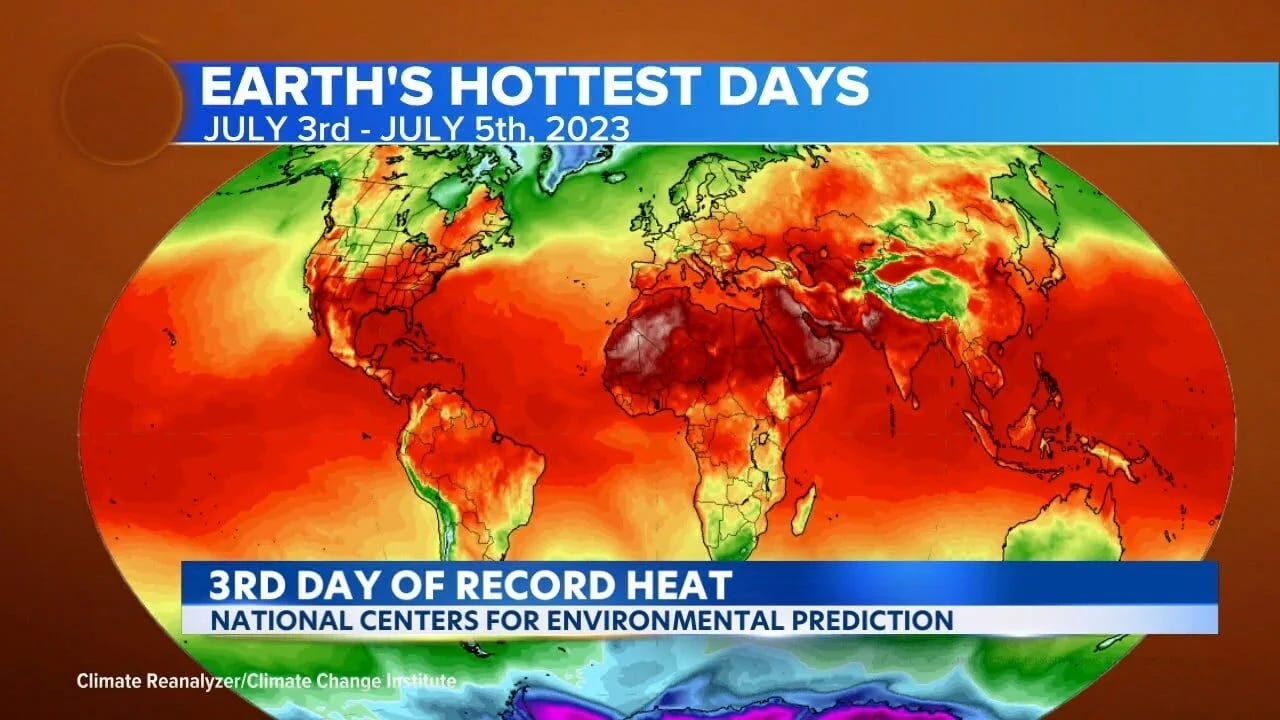
The hottest series of days in 100,000 years. The world, for its part, looked away. Nobody much noticed. Us, humankind, going through this historic, epochal change. Things will never be the same again — not even if, somehow, the temperature “goes back down,” because the planet, of course, will by then have been altered, profoundly.
Those of us who are paying attention, though, might have begun to wonder: what about this thing called “civilizational collapse”? How close is it? What does it really mean?
I began watching “The Last of Us” recently. Good show. Entertaining show. A portrait — among many — of a “post-apocalyptic” time. A great cataclysm has happened, in this case, a pandemic. Now, something funny happens in “post-apocalyptic” shows, books, movies — something revealing of the larger topic of civilizational collapse. The government becomes the enemy. So in “the Last of Us,” the real villain isn’t the fungus, it’s…the remnants of the Federal Government. LOL. That, of course, is very American. The government’s the bad guy! They’re out to get us! These are libertarian fantasies, mostly — they’re told to reinforce the American myth that government is The Enemy of Liberty. Drama needs an antagonist, so in the “post-apocalypse,” over and over again, the bad guy is the convenient one — government.
Civilizational collapse isn’t like this. Especially, doubly, climate change driven civilizational collapse isn’t like this.This kind of culture provides a lens into what life might be like in a certain kind of place, sure — but it’s also a kind of caricature of civilizational collapse, the way it really happens.
A better analogue — at least for Western minds — is the old example, Rome. Rome didn’t fall in day, it took centuries. They were punctuated by catastrophe. Every now and then, the gates would be breached, the shining city sacked, a region lost. Systems began to fail — water, food, security. The economy stagnated, and then began to shrink. Poverty grew. Democracy, such as it was, fragmented, buckled, was dealt a body blow by tyrants, and a transition — back — to empire happened. A series of tyrants, each more foolish and venal than the last — Caligula, Nero, Commodus — almost seemed to delight in thrashing what was left into oblivion. Finally, at last, Rome split, famously merged with the church, and what was left of it shifted its imperial seat, at last, East, to “Nova Roma” — Constantinople.
All that took more than five hundred years.
Keep reading with a 7-day free trial
Subscribe to HAVENS to keep reading this post and get 7 days of free access to the full post archives.