
Are We Beginning To Hit the Limits of Human Survivability?
We Need To Talk About Wet Bulb Temperature, and What the Latest Research About It Reveals
There’s a term you’ve heard thrown around lately. It’s suddenly started to gain traction, enter public awareness a little — as we go from what UN Secretary General Antonio Guterres has called the era of global warming to “the era of global boiling.”
Wet Bulb Temperature. But what does it mean?
We’re going to discuss it. Because if you don’t know about it yet — you will. In the not so distant future, we won’t check just the temperature before we head outdoors — we’ll check the “heat index,” or the wet bulb temperature, or whatever this comes to known generally as. It’s time, then, to start becoming literate with it now.
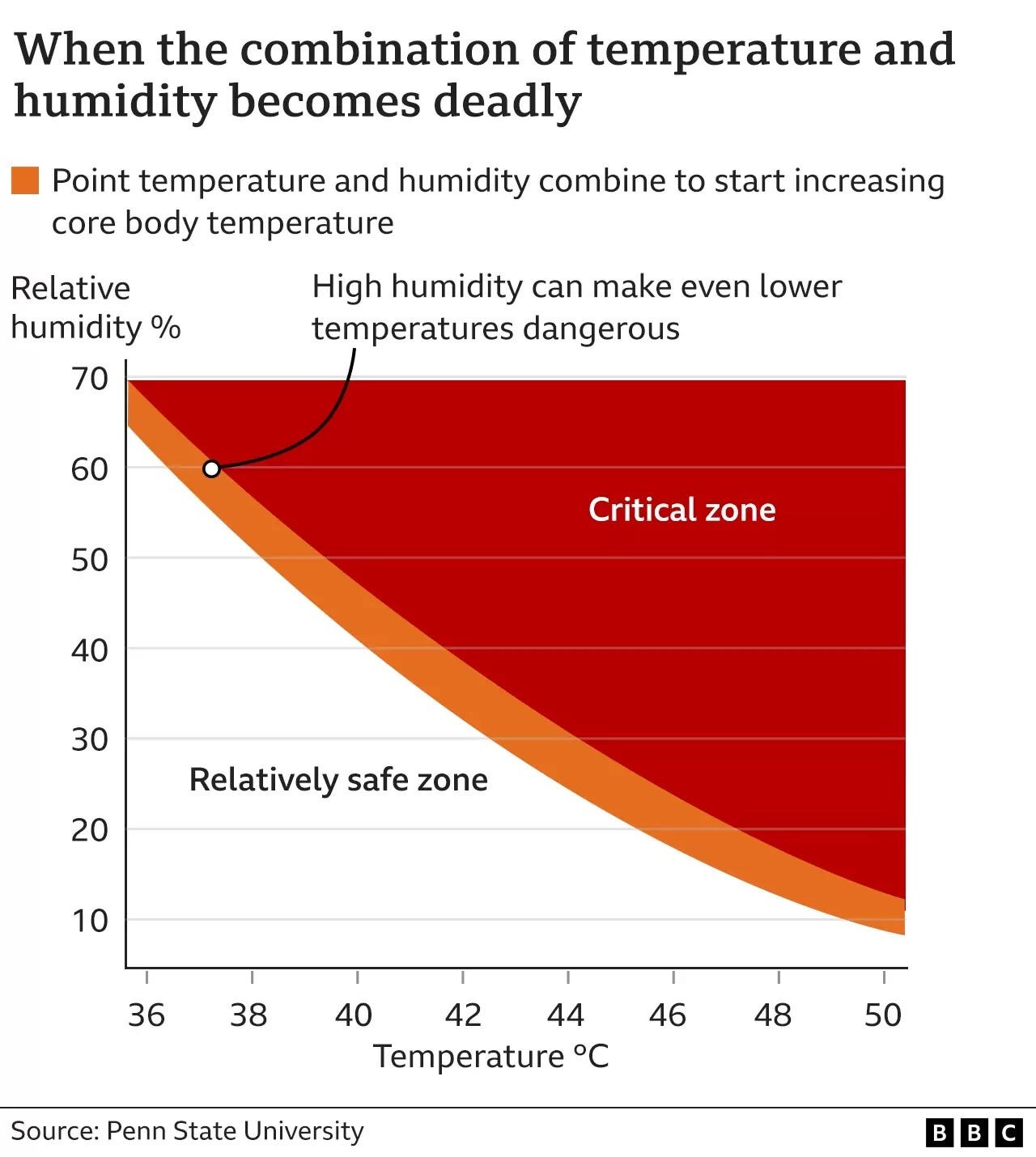
See that chart above? That’s the limits of human survivability. It’s effectively wet bulb temperature. Take a second to really look at it. It’s a new way to think about temperature for a lot of us. What does it say? At 50 degrees Celsius, and 8 to 15 percent humidity, we hit the danger zone. That’s 122 degrees Fahrenheit — and places around the world are already beginning to edge towards, if not hit, that limit.
This chart comes from the BBC, where an intrepid journalist went into the lab — to experience extreme heat for himself. We’ll come back to him. The chart itself is based on the most cutting-edge research we have into wet-bulb limits, which is why I used it — you see, our understanding of this new concept called “wet bulb temperature” is advancing, too. So what does this cutting-edge research say? What makes it different? Let me cite it directly.
A wet-bulb temperature of 35C has been theorized to be the limit to human adaptability to extreme heat, a growing concern in the face of continued and predicted accelerated climate change. Although this theorized threshold is based in physiological principles, it has not been tested using empirical data.
When the idea of wet bulb temperature was created, it meant this: “Wet-bulb temperature is read by a thermometer with a wet wick over its bulb and is affected by humidity and air movement. It represents a humid temperature at which the air is saturated and holds as much moisture as it can in the form of water vapor; a person’s sweat will not evaporate at that skin temperature.” In other words, at that temperature, the human body can’t cool itself anymore. The brain swells, the organs stop working, and shutdown happens — it’s ugly.
Keep reading with a 7-day free trial
Subscribe to HAVENS to keep reading this post and get 7 days of free access to the full post archives.