
Americans Aren’t Having Kids Because Nobody Can Afford Them
America’s Imploding Birth Rate is Another Sign of a Collapsing Society
Here’s a tiny question: why has America’s birth rate imploded? When I say imploded, I mean imploded. It’s more than halved since 1960. That’s yet another shocking — if not altogether surprising — indicator of social collapse.
America’s birth rate is now so low it’s less than two kids per couple, which of course is what you need to keep a population growing, short of immigration. This fact plays into fascist fears of “white genocide,” which I’ll come back to.
(Of course, birth rates are falling around the world. And that is a good thing. It means we can invest more in each child. But America’s birth rate seems to be not just falling, but imploding, in the last few years alone. And that speaks to a deeper problem of economic collapse that America is facing.)
You already know the answer to the question, I suspect. The right wing, in a stunning display of how foolish it’s become, blames a plummeting fertility rate on a lack of…macho, macho men. Never mind the fact that the Trumpists don’t know that, hilariously, that Village People hit was written to be a gay nightclub anthem. There’s no lack of macho men in American society. American men are as violent and backwards as they’ve ever been, maybe more so. Biden didn’t exactly stop dropping bombs and putting kids in cages. And beyond that, there’s no hormonal deficit or other biological explanation for a plummeting fertility rate. So what is it?
It’s economics, duh. Having a kid in America is unaffordable, and for that reason, it’s nothing short of terrifying.Nobody can afford to have kids anymore. I mean that in the French sense, where we say “tout le mode,” meaning a change in cultural tides and social mores — not in the overly precise sense of American pundits, who are still mystified by America’s plummeting fertility rate.
Let’s think about it. The rate has been dropping steadily in pace with the decline of the Dream. The last generation, really, to have it good in America were the boomers. And their fertility rate was pretty high, about four kids per couple. That’s because they could afford them: the dream was within reach. They could go off to stable jobs, where one person could earn enough to rear a generous host of kids, even take vacations, retire, provide for the whole nuclear family on one income. And so Boomer life was dominated by the old division of labour — men go to work, doing symbolic violence, killing each other with money instead of arrows or bullets, and women stay home and raise the young.
But sometime in the 80s, or maybe 90s, the Dream dropped dead. Gen X was the first generation to really feel the effects. It developed a culture famous for malaise and ennui. And it had less kids, too. The reason was eminently straightforward. All those Gen X’ers complaining about their crap, low-paid office jobs, the pink collar stuff of downward social mobility, couldn’t afford to have as many kids as their parents.
Enter the millennials. They’re the first generation in American history to be, as a majority, still living with their parents. Kids? A family? It’s out of reach. If you can’t move out of your folks’ house, at least in American culture, how are you going to have a family of your own? It’s not Italy or Spain, where communal living is common, and you can date and so forth under one roof. For Americans, doing so is profoundly uncomfortable. Millennials can’t afford to have kids — maybe that’s why their culture is about a permanent childhood, comic books and superhero movies and so forth.
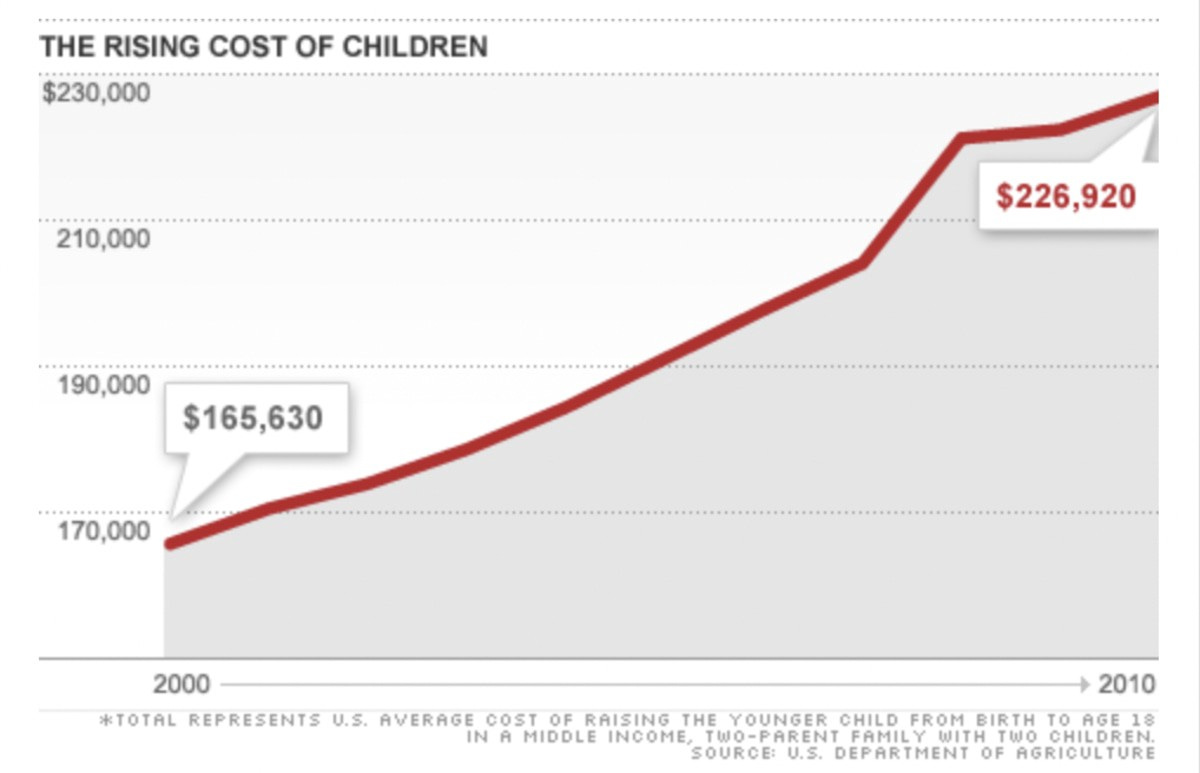
You can trace America’s plummeting fertility rate through the generations as a clear consequence of the death of the dream. Let’s run a few numbers to prove it, though. The US government estimates the cost of raising a child at $233K, which is…pretty laughable. It’s a lot, lot more than that. How much more? There’s food and clothes and medicine and housing and utilities — I calculate that at $20K, at minimum. Then there are the biggies. How do you educate a child? If you want to do it well, you’re on the hook for tuition, at a good university, of maybe $50K a year. Maybe private school runs you that much. Then there’s healthcare, which is easily $5K to $10K a year. Add it all up, and raising a child in America can easily run into the millions.
But who’s making millions? Nobody is. The average American incomes hasn’t risen in half a century. Meanwhile, the costs of basics have exploded, to eye-watering amounts, that the entire rest of the world finds completely insane and absurd. End up in the hospital? Here’s a bill for a million dollars. What the? How do you pay that? On a credit card the size of a small country?
Healthcare, food, medicine, education, utilities — these are the very things whose costs have skyrocketed in America. But their burden falls disproportionately on the young. Maybe you can get by without that medicine, that operation, new clothes, a square meal — but your kids? They probably can’t. The hidden hyperinflation that America’s seen for the basics of life makes it nearly impossible to have kids anymore. And so fewer and fewer couples are having them.
Where people are having kids in America, the rise of “alternative living arrangements” is taking hold. And that, too, makes eminent economic sense. Can’t raise a kid on your own? Maybe his three gay dads are a good thing. Maybe having all those aunts and uncles who are really childless and relatively affluent friends nearby is essential. Maybe having three couples living under one roof is a pretty good way to split the burdens of childcare and realise at least some economies of scale and scope. Societies tend to revert to communal living when individualistic lifestyles become unaffordable — and that’s rarely been more visible in the case of Americans, and their inability to afford having kids.
Such arrangement are grass-roots substitutes for another thing America lacks: public goods. In every other rich country, and even many poor ones by now, childcare is offered publicly. You have access to daycare, or community centers, or other kinds of supporting institutions. They are just a fact of life. In America, though, you’re on your own, until you stumble — and then the system steps in and tries to get you for being a bad parent, even though it hasn’t supported you in anything. Even, for example, basics like milk and diapers and so on are subsidised generously in most other rich countries, and many poor ones. In America? You get gouged, mostly. America offers no support whatsoever to aspiring families — so is it any surprise that there are fewer and fewer of them?
The burden of childcare falls, as it always has, disproportionately on women. They’re left in a double bind, a dilemma. Should I give up work, and raise our children, so we can save some money? Or should I go to work, and make money, because we can’t afford to raise these children on one income? There’s no winning this game, and American women are simply left run ragged by the insoluble dilemma of having the burdens of childcare put disproportionately on them.
Women still do the bulk of the emotional and social and cultural labour of having kids. But in America, they can scarcely afford it. And so more and more of them are simply giving up. In that sense, you can also see a falling fertility rate, in a sense, as evidence of how misogynistic a society really is. (A phenomenon which seems to be similar in Japan, as well.) Are women given the support and freedoms to have children? Or are they simply forced into roles of motherhood that they can hardly afford to shoulder?
A “fertility rate” itself can be seen as a misogynistic concept — because inherently it places the burden on women, which is very revealing of how social norms still operate. All that adds up to: not having kids is emerging as a new millennial norm precisely because having them is completely and flatly unaffordable for far too many. (There’s nothing wrong with not having kids, it should be said, it’s simply not exactly a social norm that healthy societies tend to display to this magnitude.)
What kinds of societies end up with imploding fertility rates — for so long they develop a norm of them? Economically stagnant ones do. Take Japan, as the textbook example. After its boom in the 80s, it went bust in the 90s, and has stagnated to this day. South Korea has taken over as the Asian Tiger. And Japan economic stagnation quickly produced a startling fall in fertility. There are of course cultural and social variables — some populations, especially those who’ve suffered genocides, see having lots of kids as an imperative. But by and large, falling fertility rates are a pretty good sign that a society is badly broken — it has lost its confidence, optimism, spirit, poise, because it has entered a period of stagnation, where the dream of a better future for its kids is dying.
A falling fertility rate, in some grand, abstract sense, isn’t a bad thing. We’re the most violent species on planet earth, by an incredibly long way. It’s a good thing the human race is set to peak, if it means more of the planet can live. Still, plummeting fertility has destabilising and deleterious social effects along the way.
In America, the falling fertility rate fuels fears of “white genocide,” a myth that’s at the heart of Trump’s neo-fascist movement. American whites feel badly persecuted as a social group — no, not all of them, but certainly the majority who voted for Trump and still backs him — and that persecution complex translates, as it tends to do in fascist movements, into a bizarre spectacle of projection. No, we’re not committing genocide by putting brown kids in camps where they’re tortured and sexually abused — we’re the ones at risk of genocide!
(Of course, if anyone is not at risk of genocide in today’s world, it’s white people. They make up the rich 15% of the globe. What is happening, though, is something startlingly perverse. Because white Americans are the most downwardly mobile, they are having less kids, and that translates into a feeling of shock, fear, and rage, which is expressed in paranoid fantasies like “white genocide.” There’s no genocide, but there is the fact that having kids is unaffordable in today’s America.)
Where does that leave America? Not in a good place. There aren’t going to be any large-scale changes to the social contract probably during this Presidential Adminstration, and so the fact of plummeting fertility will simply continue. Because it tends to hit already downwardly mobile whites hardest, it will feed their paranoia complex of “white genocide.” Fascism will continue to rise, and Trumpism will find fertile ground to plant its poisonous seeds in. The 80% of Republicans who back Trump — tens upon tens of millions — aren’t going away anytime soon, and the plummeting fertility rate only makes them more paranoid and hateful every single day, because they think America belongs to them, not anyone else.
There’s a very simple moral to this story, which Americans won’t want to hear. Capitalism destroyed their lives. It has destroyed their kids in so, so many ways. Making them suffer the trauma of “active shooter drills,” Making little seven year old girls set up lemonade stands to pay for brain cancer operations. Making little kids pay “lunch debt” — or go hungry. But perhaps the worst way of all that capitalism has hurt America’s kids is by making it impossible to have kids. Yesterday’s kids, who are today’s millennials, are on the cusp of an adulthood they can never reach. Their jobs don’t pay enough, they can’t afford homes of their own, where is there decent to work anyways — so who can have kids? Capitalism exploited yesterday’s kids so badly that today’s can’t have them, should they want them.
I wish Americans would learn that lesson, but you know and I know that when I say “capitalism” Americans, understandably traumatized, react with fight/flight/freeze— either they want to kill you, they bury their head in escapisms and watch the Kardashians, or they give you the blank, dead stare.
America should be a warning to the world. No, not every society needs to have or should have a skyrocketing fertility rate. But it is a warning sign when it has an imploding one. A warning sign of social collapse. That a dream has died, and left despair, ruin, and hopelessness in its wake.
Umair
March 2021